PDA

View Full Version : Messy pleco and water changes


spamn
09-08-2008, 11:13 AM
I just got a 3" pleco to help me with my algae issue. However, he seems to make as much waste as all of my fish put together. I do weekly water changes for the most part. 25% or so. I just use my gravel vac and a bucket. Then I wash my sponges out in my bucket.

My waste problem never seems to improve. My bioload is out of control now since the Pleco was added. I would have assumed that he would have cleaned up the tank. He just sleeps unde driftwood all day and poops a lot. :silly:

Any suggestions? Am I taking care of the tank wrong? I've never had a pleco before either. Also, with the gravel vac, it claims to be self starting but I'm dumb and can't get it to work so i disgustingly start the flow with my mouth. Knock on wood, I haven't sucked up any water into my mouth yet. I've noticed the suction it has is weak though. It sucks up water and that's about it. To get waste up I have to dredge the gravel and stir it up and then try to get it to flow into the vac.

What am I doing wrong here?

Thanks in advance.

excuzzzeme
09-08-2008, 11:44 AM
Plecos do seem to create much waste and it seems like you are forever cleaning it up. This is fairly normal as they can't create waste if they don't eat.

As far as your suction problem, there is no need to suck on it to get it started. You simply fill the tube with water, raise high enough to get the water to flow over the rim and then plunge it back down before it empties. It gets easier with practice.

krytan
09-08-2008, 11:44 AM
What sort of pleco do you have? A lot of plecos grow VERY large and produce a LOT of waste.

spamn
09-08-2008, 11:50 AM
What sort of pleco do you have? A lot of plecos grow VERY large and produce a LOT of waste.


The kind that sleeps a lot. Just kidding. I don't know. Up until recently I didn't even realize there were different types. I'll take a picture of him if I can. He hides under the driftwood all day camoflouged in.

I just feel that I'm doing something wrong. My water looks good, my I have white gravel and it's covered in brown algae and there is fish waste everywhere. I vacuum constantly and do water changes constantly.

spamn
09-08-2008, 12:10 PM
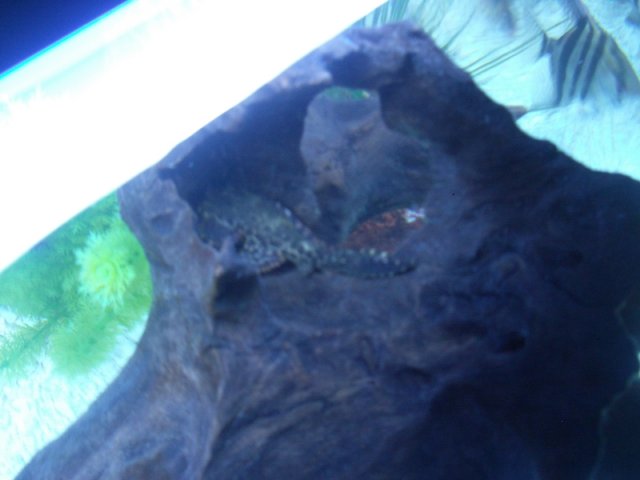
I tried to take a picture of him but since he's attached to the underside of the driftwood 24/7 and blends in, it makes it hard to see him even with the naked eye. I guess my camera isn't the greatest either though.

This is all I could get, hope you're able to tell something...

krytan
09-08-2008, 12:13 PM
It's really hard to say from that pic but it looks like a common pleco. I hope you have a big tank as they can grow to 24".

spamn
09-08-2008, 12:19 PM
My assumption was common pleco as well. He was cheap. I bought him just to be a worker more than a pet. My LFS said they do exchanges all the time. People bring in their overgrown Plecos and they will give them smaller ones. I heard they grow very quickly so I could see that becoming a hassle to exchange frequently.

My tank is a 60 gallon.

I plan on switching to marine in a little under a year. Until then, I'd like my FW community to not be so messy.

krytan
09-08-2008, 12:24 PM
I've found plecos arn't that great at eating algae and buying them to help fix an algae problem is a really bad idea. If you want a pleco i would recomend an ancistrus as these stay reasonably small.

wataugachicken
09-08-2008, 5:59 PM
welcome to the world of plecos.

larger water changes may start to help with your problems (like 50% weekly).

while a pleco may eat algae, algae feeds on excess nutrients (fish waste). by adding a fish to the tank to reduce the algae rather than cleaning it yourself, all you have done is add another stage to the algae's life cycle. unless you remove the source and the nutrients, you are going to be trapped in an endless cycle.

algae grows, fish eats algae, fish poops (massively), algae eats waste, algae grows more, etc. . . . you have to break the cycle, and part of that is not adding more fish when there is already a problem in the tank. less light, less waste, more water changes.

jaylin
09-08-2008, 6:41 PM
algae grows, fish eats algae, fish poops (massively), algae eats waste, algae grows more, etc. . . . you have to break the cycle, and part of that is not adding more fish when there is already a problem in the tank. less light, less waste, more water changes.

I'm happy someone pointed that out. If you want to fix a problem, you have to address the problem, not the symptom. In this case, the problem is an overload of nitrates the symptom is excessive algae growth. So, you need to find a way to reduce the amount of nitrates. There's two ways to do that: Live plants and water changes. If you don't want to open up the can of worms that live plants can create, you'll have to stick with water changes.

Personally, I think smaller, more frequent water changes are the healthiest way to go. Start with shooting for 50% weekly change by doing two 25% changes through the week (or 5 10% changes). See how that does. If that doesn't help, go for 75% weekly by doing three 25% changes through the week.

jpappy789
09-08-2008, 6:51 PM
Wata made a very good point. More waste leads to excess nutrients which the algae will capitalize on. Most larger plecos don't relly do a good job at eating algae once they get older anyways.

A much better way to combat algae is to first start off by lowering the amount of light and cutting back on feeding and see where that gets you.

wataugachicken
09-08-2008, 6:55 PM
small changes though do not add up to one large change, even if the volume is equal.

say as an example someone has 40ppm nitrates on water change day. a 50% water change is going to remove 20ppm, leaving the tank with 20 ppm. two 25% changes leave you with almost 23ppm, plus whatever is added in the days between the changes.

5 10% changes leave you with 23.7ppm. plus additional nitrates added daily.

the differences are negligible in the example, but those amounts add up over time. when getting the same or better results with less effort and time (and water $$) invested, why not go with the larger changes?

smaller water changes are good when the tank has been neglected or water quality is quite different from tap water, but once a maintenance schedule is established and water parameters become stable (tank compared to tap) then large water changes are in no way detrimental to the fish when done properly.

SubluxT7
09-08-2008, 7:35 PM
Personally, If you are going to take him back eventually anyway, I would exchange him for some snails or otto's. Oto's will help control (not eliminate) your algae problem and get the whopping size of about 2 inches (which means you could have a decent sized school of them in that tank). Snails have a relatively small bioload and also clean very well. Good luck.

SubluxT7:headbang2:

bluekrissyspike
09-08-2008, 11:58 PM
yup...pleco's just munch on driftwood all day and most of the night and poop everywhere. they are kinda nice but make a huge mess.

spamn
09-09-2008, 12:17 AM
Thanks for all the insight. It all makes perfect sense. Not sure why I never thought of it that way though. I haven't had him very long so I will hold on to him and keep up with the weekly water changes and see how it goes. Worst comes to worst, I will take him back. My LFS is good about live exchanges as long as you bring a water sample for them to test as well. What is an Oto? A type of catfish, I assume? Not sure they carry those. I will have to take a look.

Someone mentioned cutting back on feeding.. here's a super noobie question, but what is enough? I only feed once a day now. Up until about two months ago, I fed twice a day. I have always been told put food in there. What you think is enough. If it's not eaten in 5-10 minutes, scoop the rest out and that's it.

I have problems with my food floating out my overflow as the fish are chasing it down too, though. Then again, I only feed flakes. Never bothered with anything else.

Lupin
09-09-2008, 2:57 AM
What is an Oto? A type of catfish, I assume? Not sure they carry those. I will have to take a look.
Look up Otocinclus affinis. There are many threads about otos here if you use the search function. They can be efficient in consuming algae but that should not mean they can compensate for the algae scraping as most algae will not be consumed at all. They grow to 2 inches only so they are usually fine even for small tanks.


Someone mentioned cutting back on feeding.. here's a super noobie question, but what is enough? I only feed once a day now. Up until about two months ago, I fed twice a day. I have always been told put food in there. What you think is enough. If it's not eaten in 5-10 minutes, scoop the rest out and that's it.
You can try twice a day but feed sparingly within 5 minutes. Your fish can do well without being overfed. Underfeeding is better than overfeeding as the problem with overfeeding is most fish suffer constipation and leftover foods rot in the tank causing rapid water quality deterioration.


I have problems with my food floating out my overflow as the fish are chasing it down too, though. Then again, I only feed flakes. Never bothered with anything else.
Try varying their diet. Switch off the filters when feeding but do not forget to switch them back on as the danger comes when the bacteria die from lack of oxygen due to the filters not working around.

jaylin
09-09-2008, 8:16 AM
small changes though do not add up to one large change, even if the volume is equal.

say as an example someone has 40ppm nitrates on water change day. a 50% water change is going to remove 20ppm, leaving the tank with 20 ppm. two 25% changes leave you with almost 23ppm, plus whatever is added in the days between the changes.

5 10% changes leave you with 23.7ppm. plus additional nitrates added daily.

the differences are negligible in the example, but those amounts add up over time. when getting the same or better results with less effort and time (and water $$) invested, why not go with the larger changes?

smaller water changes are good when the tank has been neglected or water quality is quite different from tap water, but once a maintenance schedule is established and water parameters become stable (tank compared to tap) then large water changes are in no way detrimental to the fish when done properly.

Gonna split hairs on me then, huh?

Sorry, I think the nitrate thing you're talking about is statistically insignificant and I think that with larger water changes you run more of a risk of crashing your bio filter or causing a major shift in pH - something fish hate. Bottom line, I've done it both ways on tanks I've had that had a large bio load and tanks stay healthier and are easier to maintain with smaller more frequent changes.

That's my opinion and I'm sticking to it. :headbang2:

wataugachicken
09-09-2008, 8:32 AM
what crashes the bio-filter? there's no truth that large water changes, when done properly, harm bacterial populations. they don't live IN the water, they live attached to surfaces in the tank. water changes do not remove them.

when one only does small water changes, water quality is more able to shift away from the parameters of the source water. if the need arises where you HAVE to do a large water change (contamination, remove medication, ammonia spike, etc) there is much more potential for harm to the fish because the water will be so different. large water changes allow the tank to be more stable because it will be more similar to the tap water. a big water change isn't harmful when the water you add is nearly identical to the water already in the tank.

while the differences in my example are small, that is Week One. in an extended example the differences would be much more clear, and also would show more of a difference if i had included nitrate build-up over a week's time as well.

you also have to take into account things other than nitrates, like TDS. in that situation, you remove a certain percent, but you also add some back into the tank. with small water changes, the TDS can build up to very high levels because not enough is being removed to (eventually) overcome the amount added back, as well as the concentration of TDS through evaporation.

bazil323
09-09-2008, 8:54 AM
What they said, lol. But seriously, plecs are notoriously not that good at algae eating. Especially when you consider that many of them are omnivorous or even carnivorous. Yours is likely a common, which does eat algae. Like was said before, you are better off just controlling the algae by limiting light, water changes, and scraping it off. The better your water quality the less likely you'll have an algae problem.

If you really, really want something to eat the algae, you are better off having shrimp or small snails. Even then you'll have some bioload. Snails are pretty messy too. I have a tank with just cherry shrimp, pond snails, and live plants, and there isn't a speck of algae in the whole tank. Granted, there is also little light coming in.

inkyjenn
09-09-2008, 9:16 AM
actually, your photo looks like you have a gibby. i have one of those. hes gone from a cute 2.5" to a 9" beast. we just moved ours from the 55 (he was too big for it with the plants) to a 75 that has a lot of driftwood and not much else. in the last two days hes probably produced over 3' of poop if you laid it all out end to end.

this is what plecos do. the best advice has been given: dont get fish to handle the maintenance of your tank. get fish for the sake of fish.

fishorama
09-09-2008, 9:38 AM
I agree with all the above & will add the white substrate shows "dirt" much better than a darker color.

What are your other fish? It sounds like you may be overfeeding, adding to the poo problem. Except for bottom feeders, I go for < 2 minutes of "flake time", 5-10 min seems too long.

shin0r
09-12-2008, 6:32 AM
Plecos make an enormous amount of crap.

I currently have a Gibbiceps, a Gold Nugget, a Rusty, a BN and a Snowball in my tank; the amount of waste is incredible. I run 2 filters and change 40% of the water twice a week. It's quite a lot of work, but plecs are awesome.