

PDA

View Full Version : DIY inline heater


Sounguru
11-05-2009, 12:00 AM
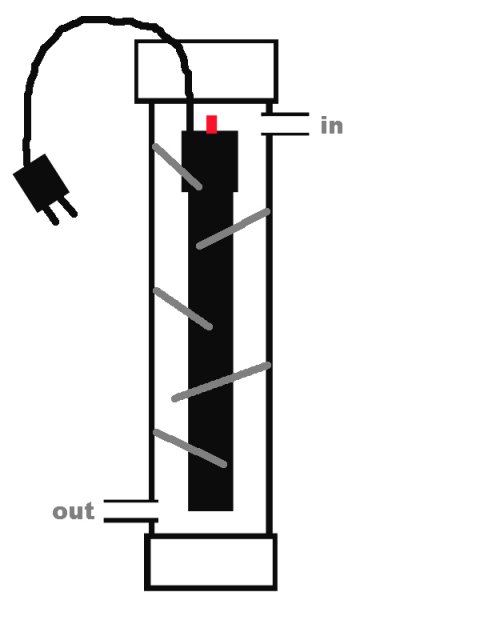
So here is my plan for an inline heater figure I can build this for under $10 since I already have the heater.

Basically it is a 2" Pvc pipe with baffles glued in that have a notch the heater rest in. This will create circulation inside the tube and give the water more contact time with the heater. The top cap will be just threaded on with plumbers tape and I will cut the cord feed it thru the cap and silicone the hole around the cord shut. The bottom cap will be sealed shut but that shouldn't present a problem when needing to clean or replace the heater. The heater is a 100 watt stealth.

Got to looking at this I think I will add an air release valve to the top cap so I can make sure that it doesn't become an air trap when priming the filter after cleaning.

Just thought I would throw it up for feedback.
mellowvision
11-05-2009, 12:36 AM
I'd add an external thermostat to this if I were to make one.

but for the cost of parts, time involved, and risk of leaking, why not just get a hydor? it's far less likely to give you trouble.

vampie
11-05-2009, 12:41 AM
Could be effective, some UV sterilizers utilize the same method to increase dwell time. Though, I'm always the first to worry about the heater touching anything.

Sounguru
11-05-2009, 1:16 AM
I'd add an external thermostat to this if I were to make one.

but for the cost of parts, time involved, and risk of leaking, why not just get a hydor? it's far less likely to give you trouble.

# 1 reason is cost a Hydor is $40+ Pvc less than $10. I have built several pipe chambers for other things just not a heater with no leaks using the same principles as seen here. an External themro would be over kill does the heater in your tank have one now unless you bought one of them there fancy ones :p:. The thing is once set and balanced to keep the water at a set temp it shouldn't need adjusting. It may take a few times to get it to the right temp but I figure there will be several tweaks as time goes on so no biggie. Plus I don't need a firm temp since the crays can live in a range of temps so as long as I hit close to a middle ground temp I'm okay. So I will probably set the temp at 78 and whatever comes out the out tube should be just fine that should negate the need to even tweak it.
So I figure it $10 for parts which I will be able to build 3 or 4 of these so lets say $5 for the parts on this one and the 30 minutes taking to build it @ say $15 per hour makes it $12.50 to build against $40 for a hydor.


Could be effective, some UV sterilizers utilize the same method to increase dwell time. Though, I'm always the first to worry about the heater touching anything.

As far as anything touching the heater you have clips that hold it in place and those touch the heater. ;)

vampie
11-05-2009, 1:22 AM
Yeah, but they don't actually touch the heating element.

BigNorsk
11-05-2009, 1:55 AM
I really don't see the purpose. If the water moves through slowly, there's a better chance the water in the tube will heat to the point where the heater turns off. Instead of getting better heating, you will get worse, as far as the tank is concerned.

Put the heater in a place where the water moves and leave it at that. Using a nonimmersion if this is a nonimmersion heater, I can't tell for sure, this way is simply begging for trouble in my opinion. If you do go ahead make sure you put the heater on a ground fault circuit interruptor circuit.

100 watts is a 100 watts. If it doesn't keept the tank warm now, it will do a poorer job with slow water movement. If your tank isn't heating properly add some water movement in the tank.

Why go through all this problem for crays who aren't really picky as far as temperature? Keep it simple.

The other thing is hot water tends to rise and cold sink, you've got it set up as if hot would sink and cold risk, the baffles are backwards, as is the entrance and exit holes.

Sounguru
11-05-2009, 3:38 AM
The water is being forced thru by a canister filter so the water will be moving across the heater faster than in the tank itself (hence inline).

The stealth is also a fully submersible heater.

This is basically the same theory as a heating module that you stick a heater in (made by lifeguard that can be seen here (http://www.drsfostersmith.com/product/prod_display.cfm?c=3578%203579%203627&pcatid=3627)). The only difference is the heater is placed fully within the unit.

Also with the tank design there will be no space inside the tank for a heater so only 3 options exist.

Under gravel heater
Hydors inline
or my design

As far as the fear of anything touching the heater my clips are touching the heater one is holding the top and the other is near the bottom so it is touching both the hot and cold parts and has been for over 2 years with no problems. A normal aquarium heater doesn't get hot enough to cook anything off and with water constantly flowing around it even if it heats way up it still will not burn.

All my aquariums are hooked into GFI plugs or power bars with fuses in case of an overload.

For those having a hard time grasping the concept here it is...

BigNorsk
11-05-2009, 4:34 AM
Okay, looks like you've got things covered, I see no reason it wouldn't work.

Rbishop
11-05-2009, 4:54 AM
Looks doable....

DiscusOnly
11-05-2009, 10:22 AM
It certainly sounds like it would work. I've seen kits like these on ebay before but you can get JEBO external heater isn't that much more. I guess if you have the heater already, you can save a few $ buiding your own but if it was me, I'll just buy an inline instead.

http://cgi.ebay.com/JEBO-External-Inline-Aquarium-Heater-100W-New-Tech_W0QQitemZ130300019617QQcmdZViewItemQQptZLH_De faultDomain_0?hash=item1e567c83a1

Sounguru
11-05-2009, 10:40 AM
It certainly sounds like it would work. I've seen kits like these on ebay before but you can get JEBO external heater isn't that much more. I guess if you have the heater already, you can save a few $ buiding your own but if it was me, I'll just buy an inline instead.

http://cgi.ebay.com/JEBO-External-Inline-Aquarium-Heater-100W-New-Tech_W0QQitemZ130300019617QQcmdZViewItemQQptZLH_De faultDomain_0?hash=item1e567c83a1

Hadn't seen the Jebo one before but I also haven't had very good luck with their in the tank heaters so it makes me a little wary. Anyone ever used the Jebo before?

Sploke
11-05-2009, 10:56 AM
Nice - one thought is to put the inlet on the bottom and the outlet on the top so any air is automatically purged when the canister is running.

CWO4GUNNER
11-05-2009, 11:08 AM
If your doing this because you want to hide or keep the heater out of the tank then it has true merit. But if you think having it in an enclosed tube with baffles to slow down water will help heat the water faster or make the heater more efficient, it cant happen.

Water conducts heat 25 times faster then air, so the less or slower the water exposure created by baffles in an enclosed system, the less effective or slower the heater will heat the tank. You may even cause a situation where the PVC not rated for heat could fail or change shape over time if you raise the thermostat in an attempt to compensate for the heaters apparent loss of effectiveness

I think your idea has merit but I would leave the baffles out or if your using them to hold the heater in place make sure they do not restrict flow at all and make sure they are made of ceramic not PVC to withstand contact heat which is high. I would also use heat rated PVC for that section of pipe and a heater that shuts itself off if run dry or overheats. This good insurance against Murphy's law which in this case things 3 things (water, electricity, and heat/fire) have been put in place which potentially can go wrong causing a meltdown shock or flood.

AgainI like your reason for hiding the heater and I think the added cost to make sure it causes no damage is well worth it.

*No baffle restrictions
*Heat rated PVC
*Run dry protection heater (hydor)
*Anchors (NOT baffles) made of ceramic

bigwave
11-05-2009, 11:09 AM
I don't know that I understand the purpose of the baffles in the design. You are going to get X number of calories (heat) per hour no matter if the water flows quickly past the heater or slowly.

The baffles will only really serve to make it more complicated, not more efficient.

UV needs X number of seconds to kill a bug, that is why they have baffles, but the heat transfer doesn't need that time.

Edit: looks like I spoke to slowly.

Sounguru
11-05-2009, 11:18 AM
Thanks for the info on the baffle guys.

I will look into it they were the one thing I was debating on.

All the PVC I"m using is heat rated .... Hmmm I have a new design idea hold on drawings coming.

CWO4GUNNER
11-05-2009, 11:28 AM
You may also want to consider the convenience or hassle of trying to adjust a heater that is difficult to access.

Sounguru
11-05-2009, 11:36 AM
Not really worried about adjusting that much since the critters can withstand a wide range and I will test the flow before it is sealed and installed so I will know what the outflow temp will be.

Sounguru
11-05-2009, 12:26 PM
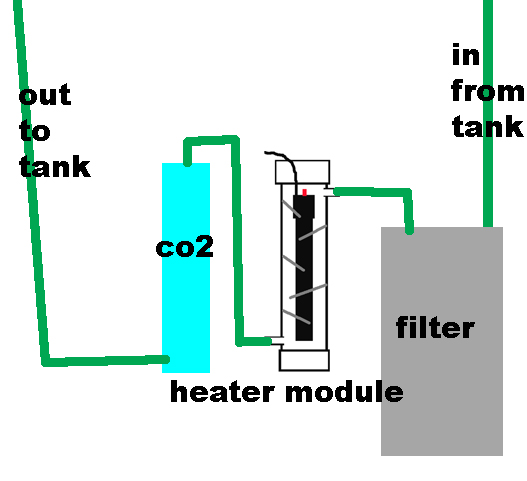
Okay round 2 of the design process...

What about this idea with the co2 input being at 90 degrees to the water input. Kind of kills 2 birds with one stone so to speak. This design would also allow me to make a bracket where the whole thing sits on the floor of the cabinet for easier access.

Sploke
11-05-2009, 1:20 PM
I still think the outlet should be at the top to eliminate having an extra mechanism to purge air.

Sounguru
11-05-2009, 1:26 PM
2 problems with the outlet at top that I see...

#1 Water movement slows since it has to fight the back pressure of pushing thru a larger column of water.

#2 Then the CO2 would go right up and out with very little chance to be assimilated into the water.

Riiz
11-05-2009, 1:41 PM
Maybe add a another valve at the top to purge any air.

Sounguru
11-05-2009, 1:52 PM
Maybe add a another valve at the top to purge any air.

That is in the original design forgot to add it to this one but it is part of the plan.

Sploke
11-05-2009, 1:55 PM
2 problems with the outlet at top that I see...

#1 Water movement slows since it has to fight the back pressure of pushing thru a larger column of water.

#2 Then the CO2 would go right up and out with very little chance to be assimilated into the water.

#1 - its a closed loop so the water would move the same speed in either direction

#2 - again, the contact time between CO2 and water will be the same as the water is moving the same speed regardless of the orientation of the middle path. If your canister is running and you pick the middle of the hose up high, the output speed doesn't change. That is because it is pulling water from one height and returning it to the same height - net-zero loss due to head height. the only losses in the system are due to static friction of canister, plumbing, and filter media.

The Zigman
11-05-2009, 2:00 PM
you could take another easy way out, and buy an inline heater housing, and install your own heater into it..

http://www.drsfostersmith.com/product/prod_display.cfm?pcatid=3627&cmpid=03csegb&ref=3312&subref=AA&ci_src=14110944&ci_sku=0905882000000

Riiz
11-05-2009, 2:13 PM
you could take another easy way out, and buy an inline heater housing, and install your own heater into it..

http://www.drsfostersmith.com/product/prod_display.cfm?pcatid=3627&cmpid=03csegb&ref=3312&subref=AA&ci_src=14110944&ci_sku=0905882000000

These cost almost as much as a inline hydor heater, and no heating element is included, ouch.


Back to the OP, if you moved one of the valves to the top, and made that your inlet, then you've basically just created a CO2 reactor with a heater included.

bigwave
11-05-2009, 2:17 PM
Another easy way out: http://www.drsfostersmith.com/product/prod_display.cfm?c=3578+3743+18444&pcatid=18444

I use this as my intake, since you HAVE to have an intake of some sort anyway, and then just run your CO2 into the intake of this heater. The caniser filter mashes up the CO2 and you get no airbubbles in the output.

25 to 35 dollars isn't too bad.

I have had that setup running for over a year and am REALLY happy with it.

PS - I realize this spoils some of the DIY aspects of the project, but on the positive side, you could DIY something else!!!:clap:

PPS - To fix the air bubble problem in your latest diagram, just turn the ENTIRE unit upside down. Make it a U shape with the input at the top, down over the heater, and back up to the outlet, then you don't have to worry about bubbles.

Sounguru
11-05-2009, 2:59 PM
Man Bigwave you really know how to crush someones Mojo.....:hitting:

The u idea is somehthing to think about....

So what about laying the whole thing on its side?

bigwave
11-05-2009, 3:21 PM
I'm at work, so I can't make this fancy, but this is what I meant, it will push air bubbles out, if you are worried about that. (Turn the heater back right side up of course)

110081

Ozymandias
11-05-2009, 3:45 PM
wow havent posted in a while you might look into a Heyco Cordgrips (got this for free with there free samples) to hold the heater and still have the temp nob out of the water so you can adjust it. i build a inline heater/CO2 reactor using this and it worked pretty good.

here's a link to the plans i followed (sort of) i just added a tube in to inject CO2
http://www.plantedtank.net/forums/diy/36257-diy-external-heater-56k.html

just think this might be a little bit simpler than what you guys have been talking about

Sounguru
11-05-2009, 3:47 PM
I'm at work, so I can't make this fancy, but this is what I meant, it will push air bubbles out, if you are worried about that. (Turn the heater back right side up of course)

110081

I knew what you mean but then the sideways Idea hit me too.:grinyes:

coach_z
11-05-2009, 3:51 PM
i was just giong to say flip #2 upside down and you would be good to go...you might want some bio-balls in there....

Sounguru
11-05-2009, 4:02 PM
The link for the water tight fittings is no good but I'm looking for them now because I like the idea.

*Update*

Found the place ordered 4 samples 2 black and 2 gray....

Ozymandias
11-05-2009, 5:30 PM
ya thay work well and i never had any leaking issue with them but i didn't really mess around with it that much. i know other people have used them and had them leak so test them out and see how you like them. should make this project easier.

Sounguru
11-05-2009, 9:17 PM
ya thay work well and i never had any leaking issue with them but i didn't really mess around with it that much. i know other people have used them and had them leak so test them out and see how you like them. should make this project easier.

Will do and I agree they should make it a lot easier thanks for all the input guys.:worthy:

JimL
11-05-2009, 9:44 PM
I found a more complex version when I googled "Heyco Cordgrips"
http://www.plantedtank.net/forums/diy/95149-diy-rex-reactor-heater-ph-probe.html

Ozymandias
11-05-2009, 11:27 PM
ya same idea just with more stuff tacked onto it. when i build a big tank (say over 100 gallons) i will probably know do something like that with the probes and all.

Sounguru
11-13-2009, 3:51 AM
Okay I built my heater and below you can see the picture of the entire deal. I did some research and had some help from a few people that led me to the Helco water tight cord wrap you can see on the end that allows me to adjust the heater. Now when I build up the next 29 I will have full build photos of the thing but right now it is still in the testing stage. No leaks so far and using a 300 watt jebo heater it seems to be working like a champ. It heats and cools rather rapidly and I'm having to adjust by feel since I can not see the actual temp gauge on the heater and it is not the most precise anyway.

I also built a spray bar for my c-160 and it makes a huge difference in the outflow of the filter but again I will show the build for that on the 29 I'm working on now.
