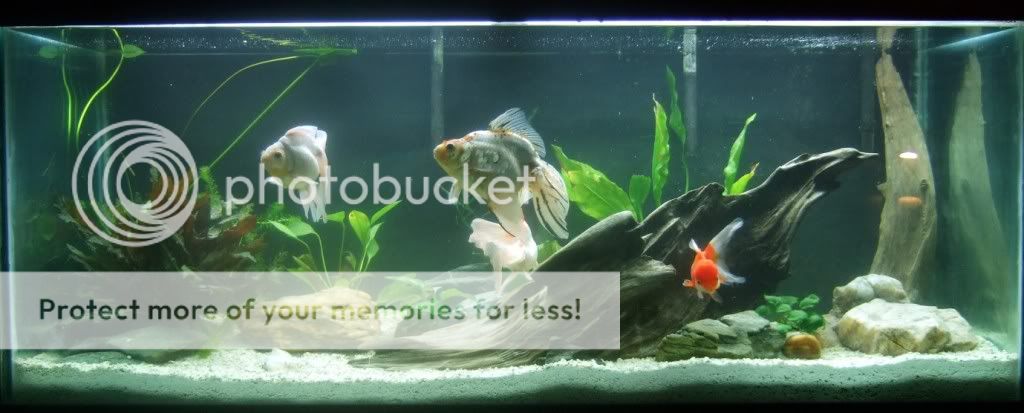
Goldfish & Plants

kazinvan

AC Members
Oct 27, 2008
80
0
6
52
I recently purchased a 72G bowfront off CL :headbang2:and I plan to move my wife's goldfish into it so they have more space. I'll likely get a few more, maybe a total of six. I have a 4-light fixture, but I think I'll only run 2x65W 6700K bulbs in it to avoid an algae problem. I know that isn't a lot of light, but I'm not planning a planted tank, just a few to make things look nice.

Water will not be heated, just room temp. Can anyone give me some ideas what types of plants may work? I know goldfish will eat some plants and a lot of varieties need warm water, so I'm not sure what to get. In their current tank I have a sword that seems to be doing well. It doesn't grow quickly but still looks good.
 
Swords and ferns are a good bet. I also keep large vals and anubias with mine, as well as tiger lotuses (loti?). The main problem is not necessarily with them eating them ( but they will) as it is them rooting up plants to get to your substrate.
 
I have amazon swords, anubias, crypts, and a pond variety water lily in my planted 80 gal, along with some anacharis and water lettuce and amazon frogbit. My goldies so far have not snacked on my plants, except for their daily duckweed snack. They really love to eat the duckweed.

Kristinaspictures1072.jpg


My lighting is a regular 4 foot shoplight with one 6500K T8 bulb. My plants are growing and thriving. I need to get an updated pic, the plants have REALLY filled in in the last month.

Kristina
 
I have vals, crypts, anubias, hornswort and swords in my goldfish tank.

By the way, Kristina, that's a good lookin' goldfish tank. Gorgeous goldfish too.
 
Live Plants

It has been almost every goldfish enthusiast’s dream to attempt mixing plants and goldfish together in the same tank without the latter trying to turn them into a salad bowl. Though this is a little tricky to achieve, it is not impossible to mix both contrary to popular belief that goldfish will eat almost any plant that you place in their tank. Please be sure to research every plant you like before attempting them. The use of live plants has been widely encouraged in the hobby as they help improve water quality, provide food and refuge for the fish and add up to the natural beauty of the tank setup.

The first thing to consider is the temperature. Most plants that thrive in the tropics are unable to tolerate the coldwater to subtropical (range of 58-76 degrees Fahrenheit) environment required by the goldfish. They tend to turn glassy and eventually wither away if the temperature becomes unfavorable for them.

Secondly, some plants need high lighting whereas others require moderate to low light conditions. With high lighting conditions, CO2 injection may be necessary to allow the plants to compete efficiently with the algae before algal blooms are expected which are a bane in almost every planted setup as they become unsightly in vast growths. Unfortunately, as goldfish are large oxygen consumers, the CO2 injection may not be useful here especially if your filter is creating powerful turbulence that disperses the CO2 out of the water column therefore rendering the CO2 injection useless.

Thirdly, goldfish are avid grazers. They tend to graze around the bottom in search for food. While floating plants and plants that attach to any decorations will not have an issue with this, rooted plants unfortunately are met by this problem and are likely uprooted in the process as the goldfish attempts to move the substrate aside as they dig around. If you hope to successfully establish the plants, plan ahead and start laying out the plants where they should be before you get your fish. This will give the plants a head start to firmly root themselves in their place. You could also place large rocks or weights near the roots but be sure there is aeration around that area to prevent choking the plant roots which will subsequently kill the plant.

It is wisely recommended for beginners to start with plants that are relatively easy to keep and are undemanding without the use of high lights and CO2 injection. Remember to take it slow and easy as it is important that a good and slow start will make your experience a fruitful one. For a good start, try to get floating plants such as Pistia stratiotes, hornworts, water hyacinths and duckweeds. Keep your tank open-topped as most of the plants mentioned do not like condensation droplets forming on their leaves particularly the Pistia stratiotes and will eventually rot quickly. Although the duckweeds are firm favorite salads by all goldfish, by the time they have reproduce enough to sustain their number, they will work excellently in consuming nitrate level thus improving the water quality like other species of floating plants suggested although nothing will still replace the water changes as the top method for reducing nitrate and other nutrients. The hornworts are unlikely to be consumed as they prickle the mouths of the fish as it does with other fish that are urged by the temptation to eat it. Duckweeds, water hyacinths and P. stratiotes reproduce rather quickly through runners and can quickly carpet the whole surface area so be sure to trim them out when necessary. Hornworts reproduce by cutting and with their brittle leaves and stems, they can be messy and can clog some filtration systems.

Java ferns, Java moss and anubias are also tough choices and with their rather unpleasant taste, they make wise choices for a planted goldfish setup. Although Java ferns and anubias are low light plants thus making them easier to keep than most species, they are extremely slow growers. They need to be tied with nylon thread, string or fishing line into place on a decoration but not too tightly that the rhizomes become severed. Java moss, on the other hand, do not need too much attention as it will readily attach on anything and carpet it completely so be sure to trim them down if you do not like a rather bushy plant area.

For rooted plants, a good suggestion would be an array of Cryptocoryne sp., Echinodorus sp., Vallisneria sp., Sagittaria sp., Egeria densa, Egeria canadiensis, Hygrophila sp., Nymphaea sp. and Aponogeton sp. As all are rooted plants, be sure that these are planted firmly to the substrate and the white crown is not covered entirely or the plants will suffer Cryptocoryne rot which involves the plant melting although it will eventually recover but this may take some time and is best avoided. Cryptocoryne species are far more prone to Cryptocoryne rot than anything else so avoid transplanting them around too much. Finalize the layout before you try to stick them where they should be. The first four plants mentioned reproduce by runners and can quickly carpet the setup in time depending on the conditions provided. Hygrophila sp. and Egeria sp. can be reproduced by cuttings similarly with hornworts although the latter is not purely a rooted plant and is best kept afloat. A lot of goldfish favor the Egeria densa so do not be surprised if you find this plant left with a stalk instead. The leaves are too much for the goldfish to resist. The last two plants suggested Nymphaea and Aponogeton reproduce by bulbs. The Nymphaea sp. especially is an extremely beautiful plant with lushy leaf growths and even sprout flowers on the surface if allowed so be sure not to enclose your tank with a lid if you want to see the flowers sprouting and adding up to the beauty of the goldfish setup. The bulb can be left on its own although burying it halfway down will help it establish firmly its ground. To allow the young leaves to grow well, the leafy stalks that reach the surface may need to be trimmed down and this also helps prevent clogging of the surface with too many floating plants.

Lastly, it must be noted that each person has a different experience in regards to a particular plant compared to another so what may work for one may not work for the other. This must be kept in mind at all times and consider this, goldfish are extremely personable and they tend to choose their food at their own will so it is not surprising a lone comet would chomp down water lettuce and hornworts while another avoids both plants entirely. As much as possible, be sure to test each plant and plan backups in case your attempt does not work. Some plants are quite rare and expensive so it may be advisable these ones are best avoided unless you have an unlimited source and do not mind losing a single plant or two with high market value.
 
Thanks for the great feedback. I'm not new to fish keeping but I am to goldfish. My wife loves them so I'm trying to do the same, LOL. They have never been my first choice, but the fancy types are growing on me, especially the ranchu (just something about those little hunchbacks :) )
 
I've been fighting with a planted goldfish tank for about a month now. Simply put, the fish haven't eaten any plant to death. I've been having more trouble with other environmental factors such as light, nutrients, and water hardness.

As has been mentioned the fish do like to upset the substrate and make me replant things over and over again. If anything, the messy goldfish help me ensure an ample supply of Nitrate and Phosphates. I add trace and Potassium.
 
Josh, could you please list down those plants that were not destroyed by the fish? What strains of goldies were tried on them?
 
Here's a quick summary of my trials:

60 Gallon tank, 8 goldfish, 4 loaches, 1 pleco.
5 x 54W T5 HO hood on 8 hours daily
Two bottles of DIY CO2 supplemented with Excel as directed
Initially used Flourish and Flourish Trace. Switched two weeks ago to dry ferts: CSM+B and Potassium Sulfate, plus root tabs.

Typical water conditions:
Ammo: 0
Nitrite: 0
Nitrate: 40+
Phosphate: 4 ppm
PH: 7.8 - 8.0

First batch of plants (http://www.aquariumplants.com):

Red Melon Sword: Mature larger leaves were eaten and damaged by the pleco within two weeks. There is still an ample established and healthy core of new leaves. Some light hair algae problems.

Anubias barteri: Slowly and happily growing. No problems after I finally tied it to some wood instead of burying it. Sending off two or three new shoots. Algae is persistent on this slow grower, both hair and green spot types.

Corkscrew Vals: Have been suffering a slow death. I've still have a few good-sized plants, but they have been going downhill from the beginning. Yellows in some spots initially, some diatoms cling to them, they wither, slowly rot. I cut off Excel for two weeks and saw no change.

Marimo "Moss" Balls: These have fuzzed up like crazy. I'm pretty sure a couple are trying to send off tufts and multiply already. It seems algae is one thing that can thrive in my tank.

Cryptocoryne wendtii (Red, and "Florida Sunset"): Were slow to establish, but look better now. Plagued by hair algae. Old growth was mostly green, flat and became full of small holes not long after introduction. New growth seems to have responded to the high light wattage, and is a deep brown with dark markings. Very wavy/wrinkled, but has a healthy looking gloss.

Baby Tears: Pestered by the fish, and what was left quickly browned and died. No idea.

Bacopa: The stalks started out brownish and may not have been healthy to begin with. The tops began to green up and responded to the light, but they seemed to keep rotting from the bottom until the stalks were too short to replant. They were frequently uprooted by the fish, but were never properly established or rooted.

Frogbit: Rather than floating plants as I expected, I got some small heart-shaped and rooted leafy plants that I planted in the gravel. They greened-up, got molested by the fish, and promptly rotted in the space of a week.


Intermediate Additions (LFS Petsmart)

Cabomba: Easily uprooted and frequently replanted. Seems to love my lighting. The tops are each a much different and brighter shade of green by the end of the day. Seems to completely reject algae. A bit of a surprise for me, because the chick at Petsmart tried to talk me out of them because so many people she had talked to were having trouble keeping them.

Amazon Sword: The same chick mentioned above crammed this beautiful sword into a small bag, which came open in the car on the hour-ride home. The ends of every leaf were in the open air and burned, then rotted when placed in the tank. The plant has ample roots, and shows signs of new growth.


Second batch order of plants (about two weeks ago, http://tntaquatica.com):

Hemianthus callitrichoides
: Overnight fish food.

Eleocharis parvula (Dwarf hairgrass):
Looks reasonably healthy and enjoys my lighting, though I suspect each planting site is slowly getting picked at and shrinking.

Lilaeopsis mauritiana: As above, though this larger grassy plant seems to be more durable and is faring better. It may even be spreading slightly already.

Didiplis diandra: Started with a couple of small stalks. They had a hard start, but are now greening up and looking promising.

Alternanthera reineckii "lilacina"
: 80% rotted. Did not establish.

Ludwigia glandulosa
: As above. I was definitely pushing my luck with water parameters for these two plants, but risked it on the color potential.

Rotala wallichii: Dead. The specimens I received were pathetic, and they were quickly molested without every really getting a fair chance.

 
Last edited:
Forgot one:

Water Witsteria: Seemed stifled by diatoms, but some recent new growth seems promising. I think it is responding to the dry ferts. Messy plant, delicate foliage.
 
AquariaCentral.com