View Full Version : Extensive African Dwarf Frog Article - Revised
Leopardess
11-02-2004, 7:11 PM
Common Name: African Dwarf frogs
Scientific Name: Hymenochirus boettgeri/ Hymenochirus curtipes
Temperature: 70-84F
Max Size: 1.5 in
What are African Dwarf frogs (ADF’s)?
ADF’s are fully aquatic frogs that spend their entire life under water. They do not need or use land at any point in their life. Dwarf Frogs belong to the Pipidae family, which consists of tongueless, mostly warm-water tropical frogs.
Why are there two scientific names listed?
While most information (online at least) pertains to the name Hymenochirus boettgeri, there may be another species of frog that is nearly identical to the layman (in appearance, size, behavior etc.), called Hymenochirus curtipes, which may have less “warts” or bumps on its skin, although there is debate as to the identification (or even exitence) of the two. It seems as though any major distinction between the two is in the larval and egg stage. Both are interchangeable in an aquarium setting.
If you are interested in reading more about the difference between the two species you can Click Here (http://davidcecere.pipidae.org/discrepencies.htm).
Further more, there may be four species in the Hymenochris genus, with the other two being: H. boulengeri and H. feae.
In actuality, the differences between these purported species are not well documented and little is known about the state of the species. Some suspect that the vast majority of frogs are now a crossbreed between two species - with "pure" specimens seemingly impossible to find in the wild due to habitat destruction. Because the vast majority of these frogs are captive-bred, the possibility of them actually being hybrids is valid.
In other words, no one really knows. The lines of descent and relation between members of the Hymenochirus genus are widely contested.
For all intents and purposes, using Hymenochirus boettgeri is accepted. There are no differences in the care required for the animal and nomenclature is of little importance to the well-being of this creature in the aquarium.
If they are fully aquatic, how do they breathe? I don’t see any gills.
They breathe much like a betta or other anabantoids - except they cannot take any air in directly from the water; they must breathe atmospheric air just like us. If you watch a frog for a few minutes, you will see that they come up to the surface very quickly and strike the water. This is them taking in a gulp of air (sometimes, they will let out little bubbles after they take a breath). Then, they will frantically swim back down to the bottom - and they usually don’t care if anything is in their way! Rocks, plants, fish - doesn’t matter. They’ll zoom to the substrate.
Are these the same thing as African Clawed frogs?
Absolutely not! Clawed frogs get many, many times larger than African Dwarf frogs and will harm and/or eat even large fish, and will eat small fish. For more information regarding Clawed Frogs, look under the scientific name Xenopus laevis. (Note: Clawed Frogs are illegal in several states; be sure to check out the laws before you buy some illegally – without knowing it.)
How do I know if I have an African Dwarf frog and NOT an African Clawed frog?
The fastest way to tell is to look at their front feet. If they are webbed, they are African Dwarf frogs. If the front feet are not webbed, it is a clawed frog. A true African Dwarf Frog has 4 webbed fingers on each front foot and 5 webbed toes on the hind feet. Also, for the most part, there are no albino ADF’s. If you see a frog that is albino, it is safe to assume that it’s a Clawed frog. Yet another way to insure a proper ID of your frog is to look at the eyes. An Clawed frog’s eyes are positioned more on the top of the head, whereas a Dwarf frog’s eyes are located towards the sides of the head. It is important to look closely when purchasing your frog because young Clawed frogs are similar in size to young African Dwarf Frogs and can be easily mistaken for the dwarf form; it’s hard to see those tiny toes – look close!
But my supposed ADF has claws! Isn’t that a Clawed frog?
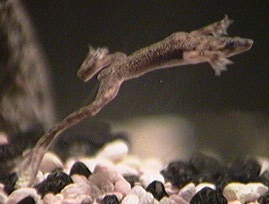
No. True ADF’s do have very small claws. They have three black claws on each of their hind feet. They do not use them to attack fish or eat their food, but they are useful to the frogs for digging and grabbing hold of surfaces to stand on.
The claws are evident in this picture of a frog lazily floating above a CO2 jet.
http://www.freewebs.com/narcisse529/crazy%20frog!.JPG
What kind of set-up does my frog require?
The best set-ups will be between 5 gallons and 29 gallons. The reason for these numbers is that 5 gallons of water is much easier to maintain than a smaller amount. If one can be very conscientious about water quality and sustaining consistent water parameters, a tank of 2.5 gallons would be acceptable for a frog or two. Tanks that are larger than 29 gallons can make finding your frog difficult since they do like to hide out, and because of ADF’s eating habits, they can be difficult to feed in larger tanks which can lead to starvation. It is therefore highly recommended that these frogs be kept in a tank no larger than 29 gallons.
Frogs, just like fish, are sensitive to ammonia, nitrite and nitrate levels. Therefore, these frogs require a filter. Any filter that is acceptable for fish is acceptable for the frogs. However, there are a few things to keep in mind when selecting the filter: 1) Frogs are not very strong and can easily be sucked up against a very over-powered filter; 2) Small/weak frogs are especially susceptible to this happening and it is advisable to ensure that the filter intake is covered - their arms and legs can get caught inside and broken (unfortunately, this isn’t a rare occurrence). Sponges/small filter covers will work to cover the filter intakes. This prevents any limbs from being sucked in.
Frogs also require a heater. Temperatures between 70-82F degrees are acceptable, though frogs can withstand higher temperatures around 86-88F if unavoidable (during summer months, for instance).
African Dwarf frogs can be a little shy and require a few hiding spaces. Caves made from smooth, aquarium-safe rocks make ideal hiding places. Aquarium-safe pots, PVC pipe, store-bought ornaments, real or fake plants, and driftwood also make wonderful safe-spots in which the frogs can hide or rest. Without sufficient hiding places, ADFs have been known to become restless and unhappy - especially if the tank has bright lighting. If your frogs feel secure and comfortable, and know that they have somewhere safe to retreat to, they are more likely to exhibit normal behavior and will come out more.
If you are setting up a Frog-Only tank, you may want to consider using a smooth sand substrate. These frogs really like to dig around looking for food or making little holes to sit in. Sand is also very gentle on their skin since they are almost always in contact with the substrate. ADF’s, however, will be perfectly fine if placed with regular aquarium gravel - anything that isn’t particularly sharp will work.
But no matter what type of tank you use, it ABSOLUTELY MUST BE COMPLETELY COVERED. Use duct tape or window screen if necessary to eliminate any and all gaps near filters, heaters, CO2 lines, etc. ADF’s are notorious jumpers and will sometimes fly out of the water when striking the surface for air. These little guys won’t live very long on your carpet (they can dry out within minutes and endure a long, slow death since they breathe atmospheric air – it would just be a matter of time as to how long before their skin hardens and dries), so make sure that there is no way for them to escape!
To be continued...
Leopardess
11-03-2004, 9:26 AM
Can I keep more than 1 African Dwarf frog in my tank, or will they fight?
Keeping more than 1 frog in a tank is perfectly acceptable. In fact, if size permits, it is suggested to keep a couple frogs. Not only can be a lot of fun to watch several frogs interacting with each other but they really seem to enjoy huddling up together and having pals to play with. They are very peaceful towards one another and may even sleep piled on top of each other! You may occasionally witness what seems to be a frog-fight, but it is extremely unlikely that any damage would result. It is usually a situation where one frog saw the other frog move and thought it was food! After a quick taste, he’ll let go.
As far as how many can be kept together, that depends on tank size. A very general rule to follow would be that one African Dwarf frog is approximately equal to a small/medium tetra in terms of bioload.
Can African Dwarf Frogs be kept with fish, too?
Yes, although it naturally depends on the fish. Just as some fish do not get along together, some fish are not a good combination with African Dwarf frogs. Tankmates that would not be suitable are fish that are nippy (Tiger Barbs), are aggressive and/or have large mouths (most cichlids and any large fish that is capable of consuming a small frog), or stake out their own territory on the substrate (loaches/catfish). Fish that are suitable include most peaceful community fish: tetras, rasboras, otocinclus, corydoras sp., gouramis, bettas, etc.
Most frogs can even be safely kept with smaller fish such as pygmy corydoras and shrimp.
HOWEVER: Problems can/do arise when ADF’s are kept with fish. The biggest problem is that the fish will try to consume all of the food before the frog can eat - which will eventually starve the frog. Frogs must be carefully fed and monitored to prevent this when in a community tank.
I have heard conflicting advice about whether or not I can keep ADF’s with Bettas, which is true?
Well, that all depends. Normally, African Dwarf frogs make excellent tankmates for Bettas. Mostly, the deciding factor in this situation is the temperament of the Betta the frogs will be housed with. Some bettas will not tolerate anything else with them and will nip and bite the frog. Many, if not most, bettas, will only regard the frog with mild interest and will then move on to their own business.
Sometimes, people will say that their ADF’s are vicious and attack their betta’s fins. But! - this is usually a case of mistaken identity that may be easily remedied. Also, the damage that the frog inflicts is often unnoticeable - they simply grabbed onto the betta’s fins with their mouth and hung on for a second or two while the fish moved around, trying to get the frog off.
It is relatively safe to assume that the frog saw the betta’s colorful, flowing tail and thought “Mmmm. Dinner,” and tried to take a nibble. It is generally a very innocent mistake - a mistake that occurs mostly because dwarf frogs have poor eyesight.
This may also be an indication of a hungry frog. If your frog begins to bite onto your betta’s tail, simply start feeding them more so that they are not interested in trying to get a meal out of the fish!
What do I feed my African Dwarf frog?
Because the frogs spend most of their time at the bottom of the tank, foods that float are a very poor choice for frogs. Flakes will often get eaten by the fish before the frogs can get to them and will quickly dissolve into the water - which doesn’t do anyone any good.
Sinking foods, such as Shrimp Pellets, can be used, but they carry some problems. Because frogs cannot see very well, they must use their sense of smell to detect food. Much of the time, the pellets may dissolve into the water before the frogs find them (Foods that remain uneaten and foul up the water are one of the reasons some people mistakenly believe frogs to be messy. In reality, it’s the method that is being used to feed them that is dirty!). Some frogs may try to eat the pellet before it has soften, which can cause intestinal problems leading to bloat/blockage and possibly death.
One method that works well for both the frog and the owner is to use either a small turkey baster-like apparatus (or even the little suckers that come with test kits to suck water out of the tank and into the test tube), or a pair of long tweezers (For example: Tweezers like these (http://www.widgetsupply.com/page/WS/PROD/tweezer-blunt/BBB36)). Tweezers have a bit more control than the turkey baster method.
Frozen Bloodworms are a great frog good. Thaw the worms in a small cup. When thawed, grab a couple using either the tweezers or the turkey-baster and dangle them in front of your frog. They will strike quickly and will swallow them whole. Other foods can include very small pieces of frozen krill (too big and the pieces can be hard to digest), peas, live black worms, earthworm pieces, or whatever your frog likes to eat.
PLEASE NOTE: Some people report that feeding freeze dried foods can cause bloat and/or death in their frogs. This is likely due to the frogs eating large volumes of the food before it is moist – the freeze dried food then expands in their stomachs and is very painful and can be deadly (similar to why you are not supposed to throw real rice at a wedding; the birds can eat the rice and die). Also, if possible, when feeding frozen krill, removing the “meat” from the shell (in the tail) and feeding only the meat can reduce the chances of a frog having trouble digesting the hard shell part.
Using a method like this one ensures that the frogs are eating enough and that the fish cannot get the food that is meant for the frog.
Feed the frog until its belly is rounded and full looking.
Leopardess
11-03-2004, 9:33 AM
Do I have a female frog, or a male frog?
Sexing can be difficult when the frogs are young and very small, but as they become a little more mature, it is much easier to distinguish.
Males: Behind the front arms (on their side), males have distinct white “bumps” or “pads,” which are called “nuptial” pads and sometimes referred to as “Post-Axillary Subdermal Glands.” These somehow play a part in mating. While some females have small, indistinct pads, males will have very prominent ones.
Females: Females have small protrusions between their back legs where a tail would be and lack distinct pads.
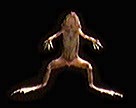
This shows a female - Notice the lack of white pads behind her arms.
http://www.freewebs.com/narcisse529/Mr%20frog%20crop%20sharpen.JPG
This picture also shows a female. Note the small bump between her back legs.
http://members.aol.com/chris420529/femalefrogbump.JPG
This photo shows a prominent white patch behind the arm of the bottom frog. This is the pad of an adult male. (Notice how they pile on each other!)
http://members.aol.com/chris420529/frognuptual.JPG
Can I breed my frogs?
Yes, it is possible to breed them in an aquarium setting but it is very difficult and many resources should be consulted to ensure proper care. The young are very hard to feed due to their small size when they are tadpoles.
Occasionally, you may hear a buzzing sound coming from your tank - something that sounds like an electrical hum or rattling filter. This is the sound of a male frog that is “in the mood.” Not all frogs will do it, so don’t be alarmed that your frogs aren’t happy if you don’t hear this sound.
Click here to listen to a quick clip of a male frog’s mating hum:
Click Here To Listen (http://allaboutfrogs.org/files/sounds/dwarflong.wav) New Link, New Sound File; 800+KB but worth it.
Click Here to Listen to Another Sample (http://allaboutfrogs.org/files/sounds/dwarfsong1.wav) - The old file. Longer, but less audible.
What’s that white skin hanging off my frog? Is he sick?
No, he’s probably fine. ADF’s shed their skin! They do it much like a snake. It will start in a few pieces (immediately before shedding the frog will look a little dull and his eyes may appear milky) and it will eventually peel off of their entire body. Sometimes it peels off bit by bit, other times it peels of in nearly one sheet! Where does it go? They eat it! A little unaPEELing, perhaps, but a nutritious treat nonetheless.
Here, you can see a sheet of skin coming off of the frog’s back.
He used his mouth to pull the skin off and ate it.
http://members.aol.com/chris420529/shedding.JPG
Some frogs will shed every week, some will naturally shed much less. It can often be hard to notice since they may do it in the night. Just don’t be alarmed if it looks like his skin is falling off! Also, some people confuse the beginning stages of shedding as a fungal infection. Please make sure your frog isn’t just shedding!
Frogskin left behind in glosso carpet after a shedding.
http://members.aol.com/chris420529/frogskin.JPG
My frog doesn’t swim around very much and stays in weird positions. Is he okay?
Chances are, he’s fine. ADF’s can be very lazy creatures, and some prefer hanging around one spot all day. Some will hide in their cave, some will come out and balance on their two hind feet for hours. Some will float at the surface as if they are dead (Don’t be too alarmed at first. Poke them gently if you feel the need and they should prove to be quite alive.). Some will do headstands and some will practice odd Yoga positions. It’s just their amusing nature.
Are ADF’s okay to keep in my planted tank, or will they harm the plants?
Directly? No. Indirectly? Maybe a little. That is, frogs will not eat your plants. They may nibble at algae (only because they see a strand of squiggly hair algae as a potential delicious worm) or because they think a snail on the leaf might be tasty (until they realize that snails have shells!), but they have no interest in eating your plants.
However, ADF’s like to hide under leaves and may cause initial trouble if trying to establish a new ground cover such as glosso or dwarf hair grass, but once the plant takes root and grows, it will be fine.
My ADF isn’t fully aquatic like you say they are…I keep catching him trying to get out of the tank!
Every so often, someone will encounter a problem – their frog keeps trying to exit the water. This is an indication that something, somewhere, is amiss. Test the water to make sure that ammonia/nitrite/nitrate levels are where they should be (0/0/<40, respectively). If the water quality is poor, sometimes frogs will try to alleviate the discomfort by exiting the water (which is bad!). Another reason is that the filter current may be too strong and the frogs are trying to find a safe place. Whatever the problem is, make CERTAIN that there is NO gaps for the frogs to escape out of the tank and that the water quality, heater, filter, and other fish are all okay.
I have a biotope tank and would like to know where Dwarf Frogs originate from. Where are they from?
Dwarf Frogs are from the Congo region of Africa in Central and Western Africa.
To be continued...
Leopardess
11-03-2004, 9:36 AM
Other related links:
http://www.xenopus.com/disease.htm - Focuses on diseases that pertain to aquatic frogs (specifically Clawed Frogs, but the science is the same for Dwarf Frogs). There are numerous links on this site to just about everything one could imagine. Most pertain to Clawed Frogs, but some are still worth a peek.
http://dels.nas.edu/ilar/jour_online/37_4/37_4Amphibians.asp - A somewhat technical article, written by Dale DeNardo, D.V.M., Ph.D., an Associate Veterinarian at the University of California, Berkeley. The article talks of amphibians for laboratory use, including the African Dwarf Frog and African Clawed Frog, among others. The important parts in this link involve the documented importance of water quality to amphibians for non-believers. There is also some detailed information on anesthetization and euthanasia using chemicals, physical methods, etc. (The information provided therein is not necessarily recommended or suggested to be 100% accurate or acceptable for the average home aquarist. It is merely provided for curiousity’s sake.) There is a large bibliography of amphibian-related publications.
http://news.nationalgeographic.com/news/2002/11/1107_021107_tadpoles.html - A National Geographic Article (based upon a juried scientific study) on the very rare feeding behavior of African Dwarf Frog tadpoles, using extreme speed and suction to suck in their prey! A neat read!
http://members.aol.com/chris420529/frognuptual2.JPG
The End:)
the_dougie
02-01-2005, 2:32 PM
how would i know if my ADF is dead? if i see them floating on the top would they look different in any way, or should i just use the poking method to find out...?
good article, i learned a lot from it.
Leopardess
02-01-2005, 7:57 PM
Well, I've read that a dead frog will often sink rather than float. When mine have died, they did float though. Usually you can tell that they just look....er....dead. You can try splashing the water with a fingertip near them or giving them a little prod. Or check if they move their eyes, etc. You kind of just have to give it a good look over.
Thank you:)
Spikor
03-01-2005, 1:32 PM
yeah this is a GREAT article on ADFs!!! I wanted to add that I feed brine shrimp in my tank. a lot of them sink to the bottom and 'lay down' and the frogs seem to love it. they get all fat after eating the shrimps! i also try to get some live worms down there at least every other day or so. and the algae wafers i put in there seem to get nipped apart by the frogs since my one tiny little flying fox couldn't do that much damage on his own....though some of the other fishes may do it too.
at any rate, i definately recommend ADFs to anyone with a smaller tank and non-aggressive fish. they are a great addition to a tank, they are comic relief for me! they are just inherently funny and silly.
great article.
katfood
03-15-2005, 3:19 AM
Hey, wonderful article. I have not seen such an in-depth exclusive dwarf frog article on the ENTIRE net. GREAT JOB!
Okay. Ive been keeping these frogs for awhile now, and used to keep fish years ago. In the last half year, I just got back into it when a friend asked me to raise his young pair of dwarf frogs until they grew enough to put into his community tank. I had an extra tank, so I said sure, no problem. His frogs looked exactly like the photos in the article. However, when the pair got big enough to give back, I got one of my own to start my own dwarf frog community (thought I'd start small and work my way up. Was also testing the LFS.) My frog is still skinny and delicate, and looks nothing like my friends do. For awhile I thought he was just young and or previously neglected at the lfs. But as time passed (I've had him for about a month and a half now) and I kept feeding him (he eats like a freakin pig), and he didn't develope any bulbous belly or fat extremities, I began to wonder.
I really thought I had a sickly little frog for awhile. I've scoured the net for literally hours about this, and came up nearly empty-handed.
After looking at tons of photos, looking on every site I can find, and even calling LFS's, this is what I can come up with.
The two varieties of dwarf frog are quite noticeably different:
It seems to me that hymenochirus curtipes is fatter in the belly area and slightly different in coloration, and also possibly a little larger as far as extremities go. It also seems they grow to be just a tad longer and tons fatter.
Hymenochirus boettgeri, on the other hand, seems to be more delicate, with thinner arms and legs and a taunt, not rounded, belly. They seem to grow to be shorter than hymenochirus curtipes, and stay quite skinny.
Here are some random web photos of some hymenochirus boettgeri:
http://allaboutfrogs.org/info/species/timdwrffrog2.jpg
http://allaboutfrogs.org/info/species/timdwrffrog.jpg
And one of my own:
http://fishiezoo.com/images/uploads/84/questionablefrog.gif
I'm not sure about the frogs in the random web photos I linked to, but my frog is nearly fully grown. He has reached sexual maturity as he has begun to sing daily and has fully developed sexual organs. So, that helps to confirm the differences between the varieties, in case anyone thought the pictured frogs may just be young.
So, in closing, I'm very sorry for the length of this post. This is all my personal experience and research. I've been all over this topic for some time now, and this is the culmination of my efforts. I'm no scientist by any means, and I *could* be wrong. But I'd like to think I'm helping to alleviate some confusion that some people (like paranoid and overly curious owners such as myself) may have.
Let me know what you guys think about this.
---
A little off topic, but I made a post awhile ago about the health of my frog in the above photo I took (the third one). I think the dwarf frog people may have missed it.
What do you think? I think he looks way pale compared to other hymeochirus boettgeri. I've obsessivly tested his water quality and done routine water changes to ensure proper health. Also have fed a mix of sinking tropical fish food and target fed brine shrimp (feed nightly). The whole batch that he came from in the lfs were this same pale color. No visible fungus, as you can see from the pic. No visible unhealthy anything. You think maybe he could just be a pale breed? This has been really driving me nuts because he acts perfectly healthy and playful, swimming all over the place and singing all the time, but looks odd. Let me know what all you dwarf frog people think, I'm really curious and have found absolutly nothing about pale dwarf frogs online.
Leopardess
03-15-2005, 11:09 AM
Thank you.
Some are just more pale than others, it seems. If all parameters check out okay, and he's positively ID'd, I wouldn't worry about it.
As for the two species of frogs, the scientific material I've read seems to have concluded that there is no real difference outside of tadpole life and egg-related..."things"...but I will look into it.
beviking
04-16-2005, 1:49 PM
Awesome article Leopardess. I should have said so a long time ago but your name and good articles/replies seem to go hand in hand. :thm:
What about night-time feedings? katfood mentioned it. Is this a way to get around community fish eating all the food?
ADFs and shrimp are o.k...? I have to imagine that young cherry shrimp are fair game if adult brine shrimp are considered food. True? Not that I'm worried about ADFs exterminating the population, just curious.
Thanks!
Leopardess
04-16-2005, 5:27 PM
Thank you beviking:) I must say the same thing can be applied to you! You're always good for a trustworthy response.
As for night feedings, it can help, but IME the cories and other fish still find the food. I always feed using tweezers (after seeing that it wouldn't work like that) and its hard to tweezer feed in the dark!
As for the shrimp, baby shrimp are probably fair game, yes. Although I did have six adult shrimp in my tank that gave birth to a new generation and about 10 of them lived (not too shabby considering I didn't even know they were in there) into adulthood. Some frogs will probably be more likely to indulge in a shrimpy snack...but a full belly goes a long way in avoiding it. That said, cherry shrimp may be another story. Given the high cost of them, it just seems more prudent not to mix them in the event that something does happen (unless you don't care about selling/keeping offspring or losing a few dollars in investment).
beviking
04-16-2005, 5:58 PM
...As for night feedings, it can help, but IME the cories and other fish still find the food....
That said, cherry shrimp may be another story. Given the high cost of them, it just seems more prudent not to mix them in the event that something does happen (unless you don't care about selling/keeping offspring or losing a few dollars in investment).
Well Bettagurl, I don't know how a frog can be healthy if it dies;) I don't think it's "happiness" could really have an effect on whether or not it floats. I'm sure some diseases will be more likely to result in a floating frog, such as bloat or twisted intestines, though. I dont think I ever said it went one way or another - just that most are reported as having sunk whereas mine floated. Interesting though.
But if one didn't keep bottom scavanging fish and only used snails and shrimp to do the job...?
Shrimp that one raises in a seperate 15gal tank that does well enough to keep up with demand...and the target tank is a 90gal with lots of hiding places (too many maybe).
Leopardess
05-14-2005, 3:40 PM
I'm sorry, I hadn't realized I left your question hanging, beviking!
If no bottom feeders are used, it may indeed work out to use nightfeedings. The issue then becomes one of the frog finding the food. They're just plain terrible at it, with the problem exascerbated in larger tanks. Some would be fine, I'm sure. And some, naturally, wouldn't. I have a frog who won't eat unless you almost push the food into its mouth.
You would have to experiment and see how things progress. I'm dealing with trying to figure out how to even feed my Brochis splendens in the 125g because the rainbowfish and congos eat their pellets even if they themselves are stuffed to the threat of explosion. If your fish behave and your frogs get into the routine, it could be a more convenient method, perhaps.
I updated a little bit on the nomenclature of the genus at the beginning of the article. Basically, its confusing so what I wrote may not make much sense (and I'll probably polish it later when I have more time) - partly because the species classification itself doesn't make much sense. I have also fixed some dead links that I hadn't known about (changed addresses) and I changed the sound bite because it wasnt working. I've got the old one, plus a new one that is a lot clearer (although my frogs are always singing at a higher pitch than the one I link to).
mugirl08
10-12-2005, 9:50 PM
I have 4 ADF's, and three of them are darker and plumper compared to the fourth, my only girl, who is skinnier and has much lighter coloring. In fact, she looks very similar to the frog in the last picture. She is perfectly healthy, so yours probably is too. However I am no expert : )
RUSH2112
10-13-2005, 5:37 AM
Leopardess GREAT INFO. I have one in a 75 gal. I am running a Fluval 404 and a Mag.350. Needless to say there is alot of current. Looks like my frog has a tough time surfacing ( I did not realize this is how they breath... no gills duhh...I'm an idiot) Is there anything I can do to make surfacing easier for the little fella ( maybe something he can get on top of closer to the surface). I am afraid he is to shy to use anything I offer. I am also afraid that this is the wrong environment and he has been in there for 9 months.
Thanks again
Leopardess
10-13-2005, 8:13 AM
Thank you:)
You could try aiming the filters in such a way that they creat a corner of lesser current. And yes, sometimes adding somethign near the surface can help. Maybe a tall plant or a terraced section? As you mentioned, however, some frogs are too skittish to come out and use these platforms. You could always get him his own little tank:D If he's been in for 9 months and is of healthy weight, he should have figured out the breathing issue. If he really has to struggle, the only "good" option would be to move him into a different tank (like a 5g). You're not an idiot, lol. Bettas have gills and they breathe atmospherically as well. And one kind of expects that something IN water breathes IN water somehow.
fishy man
10-14-2005, 1:39 PM
also another thing that i didn't see mentioned directly is never take your frogs out of the water to play with it. i have heard of people tanking their frogs out of the tank and letting there kids play with it...as lepardess said they will dry up within a small amount of time...they will be much happier in the tank and your kids will be happier with a frog in a tank then a dead frog in the toilet
Leopardess
10-14-2005, 2:29 PM
Wow. People actually do that? That's like "hmm, I want to play with my fish out of the tank." I mean, I've heard of someone thinking that "hand fed" means you have to hold him out of the water to eat really quick (?) but playing? Not to mention that contact with amphibians skin can be bad for the animal...
Maybe I'll have to add a disclaimer :rolleyes:
Captain Hook
10-22-2005, 3:37 AM
Very very good article. Nice job Leopardess! I remember reading it a long time ago without as many pictures, length, etc. The FAQ style works really well. Amazing pictures as always.
Oh forgot to ask, are they particularly sensitive to copper or anything like that? Just wondering for plant fertilizing, but it looks like you obviously don't have any deficiencies.
Leopardess
10-22-2005, 9:53 AM
Thanks Captain. They are sensitive to things like copper, kind of in the way that invertebrates are. Anything is, really, but I'd say they're more along the lines of scaleless fish and inverts when it comes to toxins like that. However, whatever you'd be dosing for your plants would be just fine. I did not have to fertilize the plants in those pictures - I just had good water - so I can't give you any specific levels.
froggirls
06-14-2007, 12:36 AM
We recently got an ADF for out little girl when we were at the pet store. He lived in a large bowl with a small goldfish. We had an issue with our cat. Suddenly after a few weeks she decided the frog would make a delicious snack. The fish was unfortunately collateral damage, found dead on the floor. After losing one frog, we replaced him with another.
A few days after getting our second frog (and fish), our little girl accidentally left the door open to where the tank was and we came home to a gruesome scene of a dead fish and missing frog. We looked around, but couldn't find the frog and had assumed he was eaten (like the last one).
Three days later while I was taking a shower, my husband came in and thought he found the frog dead on the floor. When he went to pick it up it tried to hop away!! The frog was still alive!!
We put the frog back into his tank (safely away from the cat), and he seems to have no injuries and somehow managed to stay moist for 3 days out of water! This happened tonight and he is currently swimming around and floating at the top of his tank (we keep checking, he's still alive!)
He was found between the bath tub and bath toy bucket. His life seems to have been saved by the fact that our little girls are messy in the bath tub!
Is there anything we can do to help calm him, or help him recover from this obviously devastating incident? Do you think he will survive?
aquariageek
06-18-2007, 6:49 PM
ADF's will float lazily at the surface so they can breath without swimming up and down. This is perfectly normal. As long as he does not have any wounds you can see just let him relax :)
TerryJ
08-18-2007, 9:16 AM
Thanks so much Leopardess......this article was so informative and fascinating......
I've had two little ADF's for a few weeks now.....gorgeous little things.....
When they were tiny I fed them frozen bloodworm with tweezers, then they began feeding themselves......but little devils :devil: they now wait in the hope I'll hand feed them...so sometimes I put a few bloodworm, dried or thawed between my fingers and they love pulling at them......they'll also eat flaked food like this, and it ensures my other fish don't get there first....
Animallove
12-29-2007, 11:21 PM
Are they true frogs/amphibians? or are they mislabled as african dwarf frog?
Squeakfish
01-09-2008, 1:04 AM
I didn't see hand-feeding mentioned, but it has become a pretty cool pastime with my froggy.
When I first got my frog, I was terrified that I wouldn't be able to care for her appropriately because she wouldn't come to the surface for freeze dried bloodworms. I could not feed the little thing.
Finally, I pinched a single worm between my fingers and I held it in front of her face. First, she fled in terror, but she eventually figured it out.
Now the little thing will sit in my hand if I move it close enough, and she has no trouble with being transferred from tank to tank, in my hand instead of a big frightening net. She doesn't freak out anymore whatsoever. If you decide to try hand-feeding, it actually makes the frog a good friend of yours.
msjinkzd
06-26-2008, 2:30 PM
Future discussion can be found here:
http://www.aquariacentral.com/forums/showthread.php?p=1495313#post1495313