View Full Version : Two tanks, one filter — best approach?
carpguy
04-11-2003, 7:50 PM
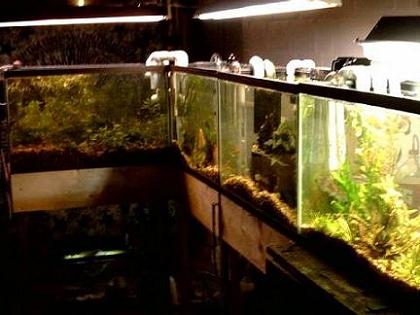
I'm still in the planning stages but I want to set up a second 30 alongside the first and would like to run it as one system.
I'd like to get an Eheim 2026 and draw from one tank and return to the other. I was thinking I could run a spraybar low across the back of each tank and run some plumbing up and over to attach them, so that the water could siphon over as the one tank empties and the other one fills.
Doe this make sense? Is there a better way to do this? Any details I need to consider? One tank will be inhabited at all times so drilling seems impractical…

famman
04-11-2003, 8:55 PM
a one inch PVC sealed pipe of any shape you care to assemble going from one tank to the second would be sufficient. You could put a screen over one end to prevent creatures from passing back and forth.
good luck
:)
JSchmidt
04-12-2003, 8:42 AM
Just hope the pipe connecting the tanks (or the screen) NEVER gets clogged...
Jim
carpguy
04-12-2003, 3:10 PM
That clogging bit is actually one of the main concerns and reasons for the post.
Also one of the reasons for the spray bar in the return tank: multiple entry points.
Any workarounds? Redundancy? An overflow? A different approach? A bad idea?
slipknottin
04-12-2003, 5:09 PM
Just put the tanks next to each other and put an inverted U connecting them both, suck the air out of the tube and your all set.
The flow rate from the canister should be high enough to keep bubbles from forming in the U-tube.
Theres no reason to worry about the spray bar, if the spray bar gets clogged it wont cause any problems.
skeletalmachine
04-12-2003, 5:37 PM
be sure to keep the pipe joining the two tanks nice and low in the water. If the water level ever made it's way to the pipe you'd be out a canister filter and a tank full of a fish, not to mention 30 gallons of water on the floor!
somefinnfishy
04-15-2003, 10:05 AM
Ok I will chime in on this one first I have set up 4 tank systems with one overflow box many diff ways and the Utube will work fine.
#1 add all the water to the first tank keep the flow through the tubes as strong as possable to prevent cloging and air build up.
#2 I like my tubes shorter so if a hose blows I'd rather my pump run dry than to empty both tanks on the floor say the 2nd tank springs a leak down low,It will leak all the water down to the depth of the tube in the second tank.I would rather come home to one dead tank instead of two.
#3 no screen I drill small holes all over the pvc pipe then cap them.I also use a couple smaller tubes instead of one bigger one If you can affors the clear ones well worth the money.
Inline 4- 29s with 600gph flow and the water level diff from the first tank to the last is only 1/2" :D
NEVER any acidents after overfilling, power outs
OrionGirl
04-15-2003, 4:10 PM
We used a similar setup with a SW 65 and 29. We had an octopus in the 29, so we had to have a fine screen on the octopus side to prevent her from going grocery shopping in the reef. It worked fine. The only problem was the occassional snail foray up the tube, which would slow the flow too much. If you are concerned something might clog the pipe, run 2. They won't run any faster, but if one gets clogged the other can carry the full flow.
ChilDawg
04-15-2003, 4:25 PM
Don't forget to have backup filtration ready if one of these tanks has some sort of outbreak of illness and the two need to be isolated for a bit.
I've run circulating ranges for many years. I make my own U-tubes from PVC, add an airline tube joint to the high point and check the U-tubes every week/10 days. I use three tubes between each pair of tanks. Sponge or mesh (depending on inhabitants) is used to restrict access between tanks.
If your fish don't mind the extra current, you can automate the air bleed by running airline tubing between the U-tube vent and the venturi intake of the powerhead -> automatic air bleed-off. But the U-tube vent is subject to clogs, so check it periodically anyway.
Pobody's nerfect. Don't do this over hardwood or rugs.
carpguy
04-15-2003, 10:21 PM
Originally posted by RTR
Don't do this over hardwood or rugs.
How about over three neighbors?
Many thanks for all the responses. I'm torn between this (practical) and building a 6' long 75g for the same spot (not so practical).
You were all supposed to say "No don't do it there will be water everywhere".
Why do you think when I built this house the tank room is a step down and waterproof? :D That where the circulating range is...
Bristlenose Chuck
04-19-2003, 4:24 AM
Maybe I'm just retarded but I dont understand how the siphon works. How do you get it to flow in the right direction? What if the siphon is stronger than the filter suction and fills the tank faster than the intake can handle? Won't you flood the floor? If someone can explain this system to me in detail (dumbed down) I'd be greatful.
carpguy
04-19-2003, 11:25 PM
One tank has the outflow to the filter, one tank has the return from the filter.
The two tanks are connected by a U-shaped tube that's been filled with water and has both ends well below the surface of each tank. This is the siphon.
As water starts to exit the outflow tank the water level begins to drop, creating a lower pressure on that side of the siphon. At about the same time water starts entering the return tank, raising the pressure on that side. This causes water to flow through the siphon from the return tank to the outflow tank to keep the pressure (and water levels) equal on both sides. The rate and direction of flow through the siphon is controlled by the flow to and from the filter — its a system trying to maintain equilibrium.
The big concern is: what happens if the siphon were to ever break (air bubbles collecting in it over time) or clog? (The outflow tank would empty out and not quite half the water in the system would flood over the sides of the return tank, at which point the filter would run dry and you'd burn out the pump -- all very bad things :( ).
You'll notice most of the posts address these two things, siphon breaks and clogging. RTR has a very clever bleed-off and along with OG favors redundancy. Somefinnfishy mentions keeping the tubes short to minimize the flooding in the worst case scenario. Somewhere in my searching on this I came across someone who mentioned drilling a small siphon-breaking hole near the top of the outflow tube so that if the water level on the outflow tank dropped too far the siphon to the filter would be broken before all that many gallons got out over the side. Somefinn also mentions using an overflow box, which would likewise help minimize potential flooding by limiting the outflow.
It seems to me that there are enough solutions to the potential problems and I'm mostly leaning towards trying a two-tank setup at this point.
Bristlenose Chuck
04-20-2003, 2:54 AM
Thank you Carpguy. If my understanding is correct, both sides of the U connector must be the same length to keep equlibrium?
carpguy
04-20-2003, 8:53 AM
The two sides of the U don't necessarily need to be the same length. Once an arm breaks the plane of the surface it becomes part of that tank.
Think water change buckets. If the bucket is lower than the tank the water flows to it. If the bucket is higher the water flows from it. If the water level in the bucket is the same as the tank, water stops flowing back and forth and the siphon just sits and holds. The length of tube on either side isn't important so long as the intake side stays submerged (if the system is at equilibrium that means both sides).
plainzwalker
05-01-2003, 7:26 AM
this is probably a dumb idea, but its something i was thinking of when i set up my tank rack. with a good canister filter, you can buy the Y valves and then you can have both in/out for the filter in each tank...
maybe im just confused..but doesnt that sound easier?
Plainzwalker - without siphons between the tanks, that solution is one guaranteed to flood. Think about it - your source is the total volume of both tanks, your output is distributed between two tanks by valves. How do you guarantee the return from each tank will exactly match the input to that tank?. It also assumes perfect valve function across either two or four valves, no fluctuations from particulates in the lines or against the valve gates of any of the lines/valves.
plainzwalker
05-01-2003, 1:58 PM
sorry :( im not that knowlegable when it comes to those types of things.. i didnt think it would cause flooding..i just thought the amount of water coming out of both tanks would equal the amount being put back in if the length of tubes where the same..
once again..i apologize :(
OrionGirl
05-01-2003, 2:09 PM
No one was criticizing you--just correcting the difference between paper logic and real world effects. It sounds like it would work your way, until you take into account the fact that even if you buy 2 pumps that are exactly the same size, set them up the same way on the same day, they won't perform exactly the same. Many of us have experimented with setups, finding new and hopefully better ways to have ever more fish tanks, so can share our experiences and prevent some of the mistakes we made.
Agree strongly w/OG. I was trying to clarify, not criticize. If it sounded like the latter, my apologies. As stated, many of us have already made these mistakes - lessons learned the hard way do tend to be lasting.