


I know overflows and wet/drys are not really big on here, but I'm hoping to get this made into a sticky so it will catch on.
So here we go.
Back round:
Wet Dry (sump) System
This is really a lot simpler than it looks and works really, really well. Water is sucked from the main and then siphoned to a water reservoir (sump). A return pump keeps the water level in the sump below a set level and the incoming water from the tank is filtered by anything you choose. May it be filter socks, scrubbies, bio balls, filter floss or anything you choose. Material's like scrubbies(pot scrubbers) are designed with a huge surface area for its size and it is my home for BB.) This constitutes the bio-filtration portion of the filter. You might assume that because the sump is a lot smaller than the original tank that there wouldn’t be enough BB to properly filter the water. The truth is that the sump has a FAR greater biological capacity than the aquarium gravel bed. The huge surface area of the bio media combined with the massive amount of oxygen available in the air makes the wet/dry system the best biological filtration available. It is almost like a bio,el, but on a larger scale. There is a problem about them tho.
While a wet/dry-sump may not polish the water the way a cannister or pressure filter would, it still does a good job of cleaning the water because of the volume of water moved. This problem can be addressed with the addition of power heads. Gravel vacuuming takes care of excess food a poop build up.
These supplies are for a 10 gallon sump, so more supplies will be needed for a large sump.
So here is how to make a sump or a wet/dry out of a 10 gallon tank.
First you need a 10 gallon tank. You can remove the top trim if needed, or you don't have to. You need a large bottle of aquarium grade silicone. The one's at your LFS are a waste of money, go to Home Depot or Lowe's and get GE silicone I(one), NOT II(two). Get a caulking gun, and two 20x12" piece's of acrylic, one 10x12" piece of glass and a glass cutting kit, egg crate and 1" diametr pvc. 10 feet(also used in the overflow, so save.) I am assuming you have a drill gun, but if you don't, pick one up also.
The first thing you do is make your drill plate. I used the acrylic here, because you have to drill it, and glass at home depot is tempered. So my bio tower is around 6"x10". So cut a piece of 6x10", it should be acrylic. In the acrylic piece I drilled 60 holes, about 1/4" in diameter, every inch. Then, leave it alone for now. Then, cut 4 pieces of pvc, 2" high. Place the egg crate on that. You do not have to silicone the egg crate. What I did was use filter floss and place it in between the pvc and egg crate. I made my bio tower 7" tall, so cut a piece of glass 7.5" in length, and 10" wide. 7.5" because you need it higher then the drip plate. You may be asking why, but I made my overflow dump water directly onto the drip plate. So if the 7.5" piece of glass was not higher then the drip plate, the water would all fall off to the side, missing the bio tower. So the point of having it higher then the drip tray is to "coral" the water so it goes over the scrubbies. Silicone the glass in place now.
This is a messy example, so I re did it. But you get the jist of it.
The blue, yellow and red things are the scrubbies. I highly recomend these over bio balls. These come in 6 packs at the dollar store. I bought 3 packs, so 18 pot scrubbers.
This was the original method, my first try.


This is the right way to make it, the way I have been writing about
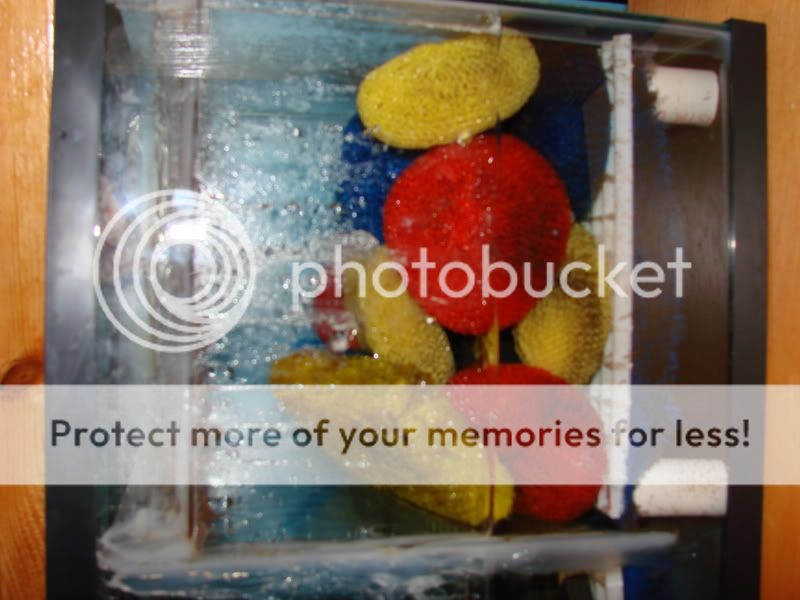
This shows my filter floss, my drip tray, egg crate, the 7.5" piece of glass and everything else I have stated so far.
That is the first part of making a sump.
So here we go.
Back round:
Wet Dry (sump) System
This is really a lot simpler than it looks and works really, really well. Water is sucked from the main and then siphoned to a water reservoir (sump). A return pump keeps the water level in the sump below a set level and the incoming water from the tank is filtered by anything you choose. May it be filter socks, scrubbies, bio balls, filter floss or anything you choose. Material's like scrubbies(pot scrubbers) are designed with a huge surface area for its size and it is my home for BB.) This constitutes the bio-filtration portion of the filter. You might assume that because the sump is a lot smaller than the original tank that there wouldn’t be enough BB to properly filter the water. The truth is that the sump has a FAR greater biological capacity than the aquarium gravel bed. The huge surface area of the bio media combined with the massive amount of oxygen available in the air makes the wet/dry system the best biological filtration available. It is almost like a bio,el, but on a larger scale. There is a problem about them tho.
While a wet/dry-sump may not polish the water the way a cannister or pressure filter would, it still does a good job of cleaning the water because of the volume of water moved. This problem can be addressed with the addition of power heads. Gravel vacuuming takes care of excess food a poop build up.
These supplies are for a 10 gallon sump, so more supplies will be needed for a large sump.
So here is how to make a sump or a wet/dry out of a 10 gallon tank.
First you need a 10 gallon tank. You can remove the top trim if needed, or you don't have to. You need a large bottle of aquarium grade silicone. The one's at your LFS are a waste of money, go to Home Depot or Lowe's and get GE silicone I(one), NOT II(two). Get a caulking gun, and two 20x12" piece's of acrylic, one 10x12" piece of glass and a glass cutting kit, egg crate and 1" diametr pvc. 10 feet(also used in the overflow, so save.) I am assuming you have a drill gun, but if you don't, pick one up also.
The first thing you do is make your drill plate. I used the acrylic here, because you have to drill it, and glass at home depot is tempered. So my bio tower is around 6"x10". So cut a piece of 6x10", it should be acrylic. In the acrylic piece I drilled 60 holes, about 1/4" in diameter, every inch. Then, leave it alone for now. Then, cut 4 pieces of pvc, 2" high. Place the egg crate on that. You do not have to silicone the egg crate. What I did was use filter floss and place it in between the pvc and egg crate. I made my bio tower 7" tall, so cut a piece of glass 7.5" in length, and 10" wide. 7.5" because you need it higher then the drip plate. You may be asking why, but I made my overflow dump water directly onto the drip plate. So if the 7.5" piece of glass was not higher then the drip plate, the water would all fall off to the side, missing the bio tower. So the point of having it higher then the drip tray is to "coral" the water so it goes over the scrubbies. Silicone the glass in place now.
This is a messy example, so I re did it. But you get the jist of it.
The blue, yellow and red things are the scrubbies. I highly recomend these over bio balls. These come in 6 packs at the dollar store. I bought 3 packs, so 18 pot scrubbers.
This was the original method, my first try.
This is the right way to make it, the way I have been writing about
This shows my filter floss, my drip tray, egg crate, the 7.5" piece of glass and everything else I have stated so far.
That is the first part of making a sump.



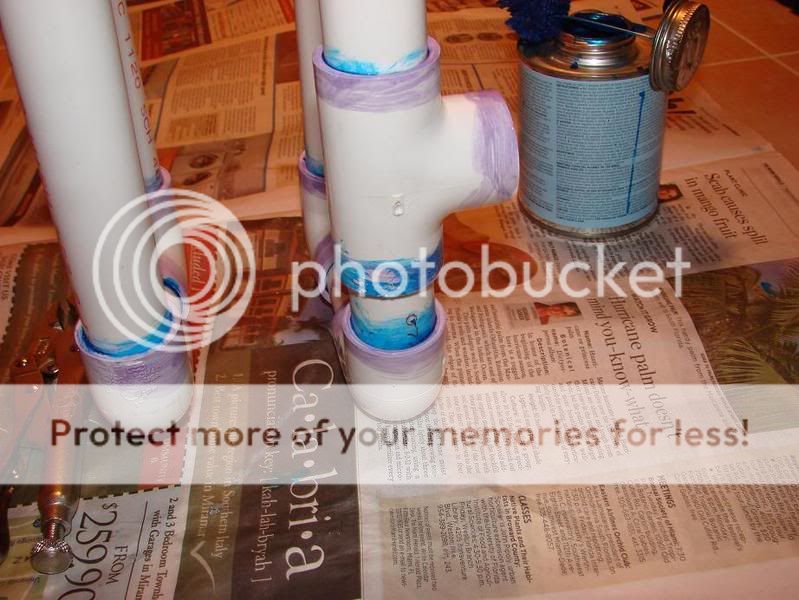


 But still I should make it look nicer then it is. When I do scrape the excess away, I will be sure to take pix. :thumbsup: