drilled vs canister filter for 90g

MotionInSilver

AC Members
Nov 14, 2007
278
1
18
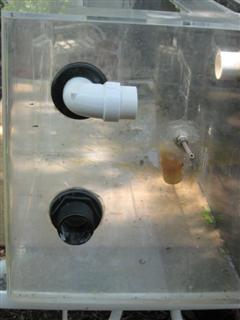
Got this 90g acrylic tank really cheap! Problem is that I've never had a drilled tank before!

Currently confused what I should be doing- I'm just going to do a DIY stand which will fit its 60''x18'' footprint as not many people have the 90g stand of 60'' they tend to have the 48'' footprint.

I've been looking at other peoples sump designs and still am at loss how it will fit just like my current openings. Or how they work as I do have many 10gs/20g/30g AGA laying around if I wanted to play around with the sump idea. THE DIY links that i've been going into isn't that helpful to explain what exactally I'm supposed to know and do from day 1.

I just recently went to my LFS- they was willing to plug up the bulkheads/holes in this tank for 20 and buff/clean up the tank for 100.

But they recomended for a freshwater set up to have canister filter set up- instead of a sump hence the plugging up the system.

I wanted to keep the bulkheads open and try that method as I was told by many others it was very efficent but I do not have any experience or anybody in my family have had that experience either. Plus I wanted to stock up the tank with thousands of nano fish- just kidding not thousands but lots of micro rasbora/danio/killie fish/ shrimp/ CPO.

Whats your opinon should I just go ahead and have it plugged up or give the plumbings a spin?

I'm also going to plan on keeping a journal for other idiots just like me.

IMG_1101_1.JPG IMG_1105.JPG IMG_1110.JPG
 
I also have a drilled 125 gallon aquarium, and I am going to plumb it to a sump. It's not hard, just setup and overflow to a smaller aquarium under the main one. I am using a 29 gallon for it.

Then you pump the water back up to the big tank, generally with a large external pump, but most any pump will do. I am looking at the Reeflo brand, Snapper or Dart model. They are not cheap, but the savings in electricity is supposed to be worth it.

My main reason to go this way is so I can get heaters, a uv sterilizer and filtration out of the tank, so it looks nice and clean. Also you increase your total water volume, so I will go from 125 to 155. The more water you have, the more likely you are to get up to 1000 fish in the tank.

My goal is similar, I want a nice school of panda cories, a handful of rams, and then plenty of small tetra's or micro rasboras.

If you need sump building ideas, I know I saw several clever ways to build them in the DIY forums here.
 
MIS:

100G is typically considered the break over point for wet/dry efficiency but as the tank is already drilled, IMHO, I would not think twice about implementing a wet/dry.

As noted previously you will need a sump which will need to be a minimum of 30G and an external pump.

I believe that efficient sumps can be made out something as simple as a Rubber Maid tub although I have only read about this concept.

TR
 
Use the plumbing for a sump. Any large FW tank will benefit greatly from a sump. If they are recommending to not have a sump, I'd find another LFS.
 
Thanks for all of the responses,

I'll definely try to go for the sump and the wet/dry method too-
 
I'm starting to get an idea how this thing works-

I drew a picture of what I'm imagining for mine I dont know if its possible or not!


I drew the picture and the intake pipes will have sponge filters covering them or is it useless?


I'm also not sure what the purpose of 3 holes is as I've no clue what it really is for or where the intakes and outtakes are really supposed to be located at.
 

Attachments

Having a sump is "another way to filter". I have been thinking of a DIY for my 55's. I have 3-55gal and a 90. Using a single pump and heater rather than 3 lessens the amount of equipment I need. I have all kinds of sketches made up trying to decide how I want it as no tank is drilled. You are limited only by your imagination as to how to lay it out. Take your time so you can do it once and have it work right. I am in the process of building one stand, will do a second one, and then by that time I will have worked out the filtering. There are plenty of ideas to be found on this site and many others - just google DIY aquarium sumps! Good luck!
 
I drew the picture and the intake pipes will have sponge filters covering them or is it useless?
More than useless as the sponges will screw up the outflow from the tank to the sump and probably cause a tank overflow. I know where you are coming from though.

In a wet/dry the filtration is principally implemented in the sump and/or secondarily implemented in a weir overflow box if one is employed.


I'm also not sure what the purpose of 3 holes is as I've no clue what it really is for ...
The top two allow the water to flow out of the tank and into the sump via gravity flow.

The bottom one allows water from the sump pump to return to the tank.

These questions make not make sense but they may lead to an appropriate setup.
  • [1] Are the top holes at the same dimension from the bottom of the tank and if not what are the dimensions?
  • [2] Did whoever you purchased the tank from say anything about a "weir box", "overflow box", etc?
  • [3] What is the diameter of the lower orifice?
  • [4] What are the diameters of the two upper pipes?

TR
 
More than useless as the sponges will screw up the outflow from the tank to the sump and probably cause a tank overflow. I know where you are coming from though.

In a wet/dry the filtration is principally implemented in the sump and/or secondarily implemented in a weir overflow box if one is employed.


The top two allow the water to flow out of the tank and into the sump via gravity flow.

The bottom one allows water from the sump pump to return to the tank.


These questions make not make sense but they may lead to an appropriate setup.
  • [1] Are the top holes at the same dimension from the bottom of the tank and if not what are the dimensions?
  • [2] Did whoever you purchased the tank from say anything about a "weir box", "overflow box", etc?
  • [3] What is the diameter of the lower orifice?
  • [4] What are the diameters of the two upper pipes?
TR

1) I'm not sure as the bottom hole prevents me from taking exact measurements but so far its 14.25'' from the bottom for the side hole and back hole is 14.5-14.75'' ish- so almost the same dimensions by less than a inch for sure.

2) no just the fact that it was used as a sump for his old 110 gal saltwater tank as It was a good price and i wanted to convert it back into display tank

3) I think 2'' for the lower hole on the side

4) I think 1'' for the top hole on the side and 1 1/2'' for the hole on the top back
 
MIS:

I guess that I was barking up the wrong tree and hence more questions.

  • [1] What is the apparatus on the left side of the tank?
  • [2] Did the tank have more plumbing which you did not bring home?

Your bitmap image is more like you are thinking in terms of typical filtration instead of wet/dry.

A typical wet/dry functions via a series of overflow and underflow weirs which creates chambers in the sump. In a wet/dry's most simplistic form the tank water, via gravity flow, enters the sump on one end at the surface and flows through:
  • [A] a chamber which contains mechanical filtration media,
  • beneath an underflow weir,

  • [C] through a chamber which contains biological filtration media, and
  • [D] above an overflow weir into a chamber where the pump return orifice is located and this orifice located at the bottom of the last chamber.

Without additional plumbing I do not understand how this flow process can function with the inflow and outflow orifices at the same end of the tank.

In addition the two top orifices being indentical in size and elevation tends to make me believe that whoever you purchased the sump from was filtering two tanks via this sump.

TR
 
AquariaCentral.com