Help Help Tetra Fish Down!!

Liquid_Pyro

AC Members
Mar 8, 2009
416
0
0
Hey, here is the story:

I have 5 glowlight tetra's in a 10 gallon divided tank, separating the 2 males from females. Two nights ago I moved 1 male and 1 female into a 2.5 gallon tank with a heater, spawning mop and air stone. They were in the tank for roughly 24hrs and when I came home from work the male was laying on the bottom of the tank (no eggs).

I then quickly put them both back into the 10 gallon. He was still breathing so I added some powder medication that said it was good for gill disease, rapid breathing and a number of other things (its all I had on hand). It has now been 24hr since I added the meds and the fish is still breathing but is still laying on the bottom of the tank.

Is there anything else I can do for this little guy? I was thinking a water change might help. Should I be adding more meds of any kind or what did I do to him?

Any help would be greatly appreciated!!

 
Hey, did you test the water in your 2.5g? What's the reading you're getting for NO2 (Nitrites), NO3 (Nitrates) & NH3 (Ammonia)? Reason I ask is if you keep it empty most of the time (when you're not trying to spawn anything) then whatever beneficial bacteria you think you had in there probably hasn't been getting enough ammonia to keep it going. As a result when you do finally add your fish in there it can result in an ammonia spike. Especially in a tank as small as a 2.5g, adding just a couple of fish could cause an ammonia spike to transpire pretty quickly. And from waht you're describing it sounds like it could be ammonia poisoning.

Test your water & see what you get for parameters. If you ammonia comes up as high, in the future, the night before you decide to shift fish over into your spawning tank, transfer a bit of filter media or anything with bb on it (piece of sponge filter, java moss etc) to the spawning tank just to ensure that you won't experience an ammonia spike in the tank we you move the breeders over.
 
did you cycle the tank? Try to make sure that the paramaters are the same in both tanks, as a sudden change in PH or temp can kill a fish.
 
No I didn't test the 2.5 gallon tank. Due to the fact as soon as I say him on the bottom of the tank I scooped both fish out and put them back in the 10 gallon and dumped the 2.5 gallon out before even thinking. I was quite disappointed at myself for letting that happen.

I filled up the 2.5 half way with water from the established 10 gallon, and then added fresh dechlorinated water from the tap. Since the fish were only going to be in there for 24hrs I didn't realize I could have an ammonia spike in such sort of a time...

All I would have to do is just add one sponge from the 10 gallon (as it has 2 sponges) into the 2.5 gallon? it doesn't have to be hooked up to an air line?

I wanted to use the 2.5 gallon as the tank was clean and there is no food on the bottom to fungus the eggs over.

Is my fish going to be alright? He is still on the bottom of the 10 gallon tank now, breathing quite heavy...all the other fish are fine, the female seems unaffected.
 
Well being that you never got a chance to test the water in the 2.5g we'll never know for sure what the cause was. However I'm going to guess that is was probably ammonia poisoning.

Filling up the 2.5 half way with water from the established 10g was a good start, but being that it's only a 2.5g, next time fill the whole thing up with water from the established 10g. Ammonia spikes can occur pretty rapidly (definitely within a 24 hour period in a 2.5g tank) if there is no bb thriving to break it down.

Also, are you running any sort of filter in the 2.5? I'd definitely be running a small sponge filter at least, even if it's just a DIY sponge filter using a polyurethane sponge (NOT cellulose) & an air line. If you're running a sponge or box filter in the 2.5g, all you would need is one of the sponges from the established 10g or some "dirty" filter media from the established 10g to stuff into your box filter, HOB filter etc that you'll be using in your 2.5g. It doesn't take a lot in a 2.5g, just a bit of "dirty" filter media (which will have bb living in it) will do the trick.

As for your fish, I can't say for sure if he'll recover but moving him back to the 10g was a good move. That will help him recover from ammonia poisoning a bit. Another method that I've used is to scoop up the affected fish in a net & have it float to the top with the fish in it, I then secure the net (with the fish in it) to the hood or rim some how (e.g. using a plastic tie up etc) to keep it afloat. This keeps the fish as close to the surface as possible & allows him to get as much oxygen as possible. This will definitely aid in your fish's recovery from Ammonia poisoning. Letting him settle to the bottom of the tank gasping for O2 will only stress him out further which can possibly kill him.

Good luck & I hope he recovers quick!
 
Last edited:
Hey LiquidPyro,

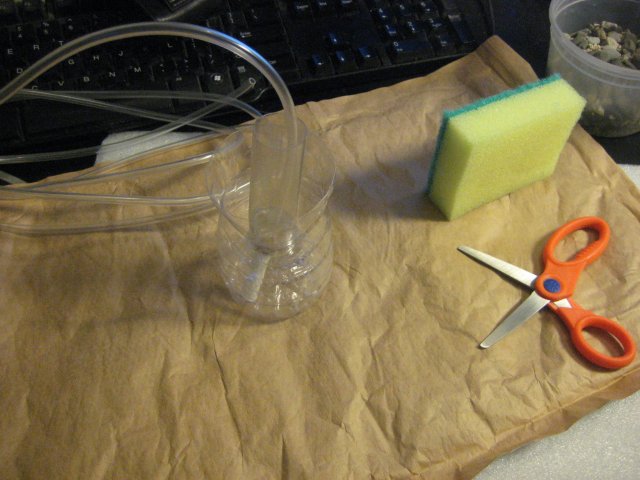
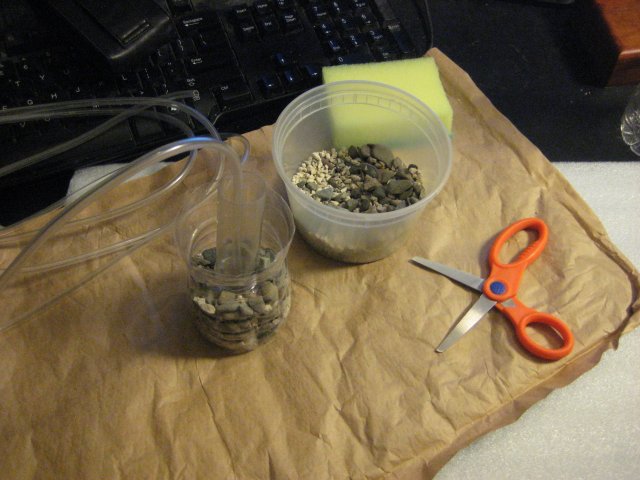
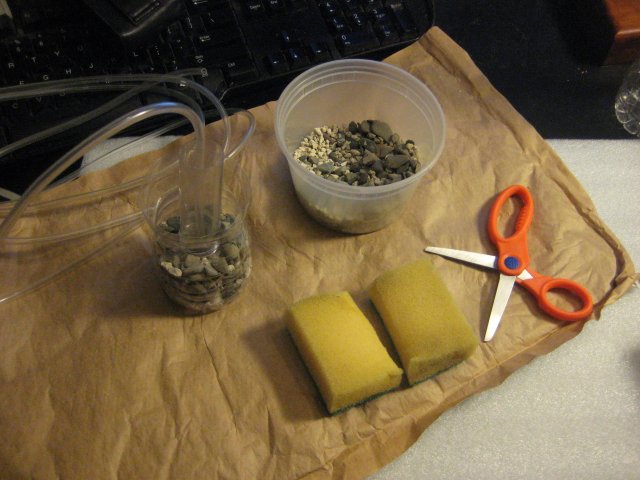
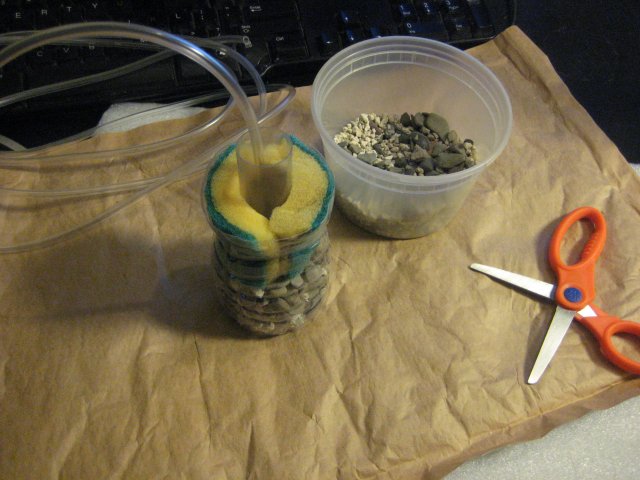
In case you wanted to make a simple DIY filter for your 2.5g, I included a few examples. The 1st one is a corner or "box" filter, the 2nd is a sponge filter.

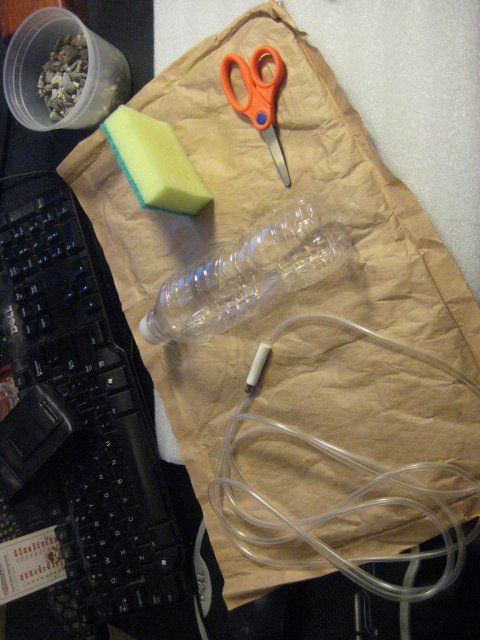
Materials you'll need will be a plastic bottle (here I used a 20oz Poland Spring Water Bottle), A polyurethane sponge, a diffuser (or air stone works too), some airline tubing, a piece of uplift tubing, and some gravel (ideally you'd want to use wet gravel from an already established tank as it will already be housing some bb in it)
001.JPG
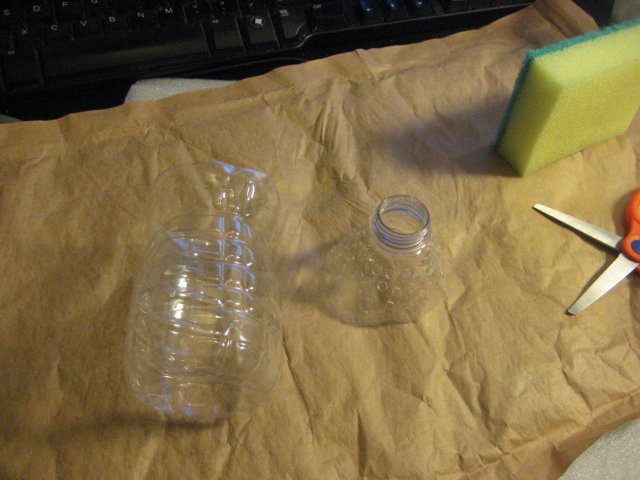
1.) Cut the bottle in half. Make two halves. The big half consisting of the bottom of the bottle will house the gravel, we'll call it the "gravel housing". The top portion of the bottle (the mouth of the bottle) will house the diffuser & support the uplift tube, we'll call it "the support". You'll want to cut some small holes into "the support" to allow for water flow throughout the filter.
002.JPG
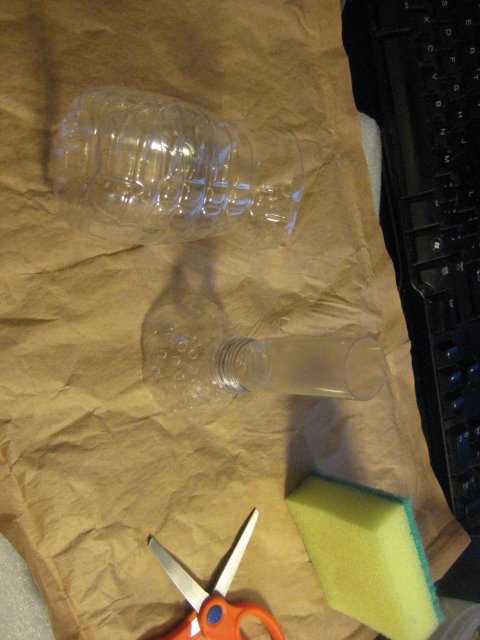
2.) Attach the uplift tube to "the support".
003.JPG
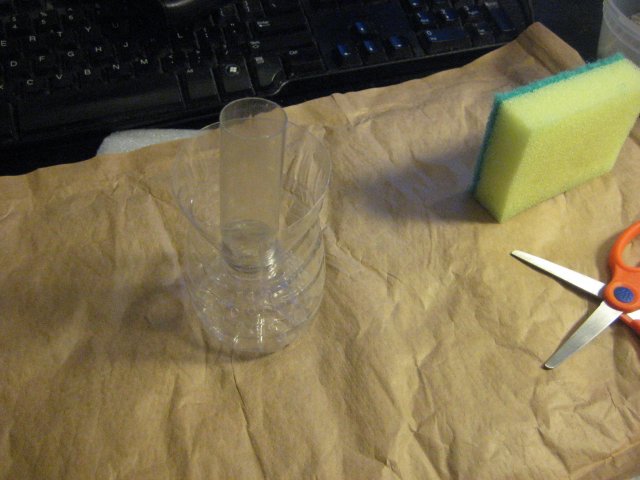
3.) Place "the support" inside the "gravel housing".
004.JPG
4.) Now feed your airline & diffuser through the uplift tube all the way down until it touches the bottom of the "gravel housing"
005.JPG
5.) Next add your gravel to the "gravel housing".
006.JPG
6.) Take your sponge & cut it in half. Once you've cut it in half, stuff the two halves into the "gravel housing" so that both halves sit on top of the gravel.007.JPG008.JPG
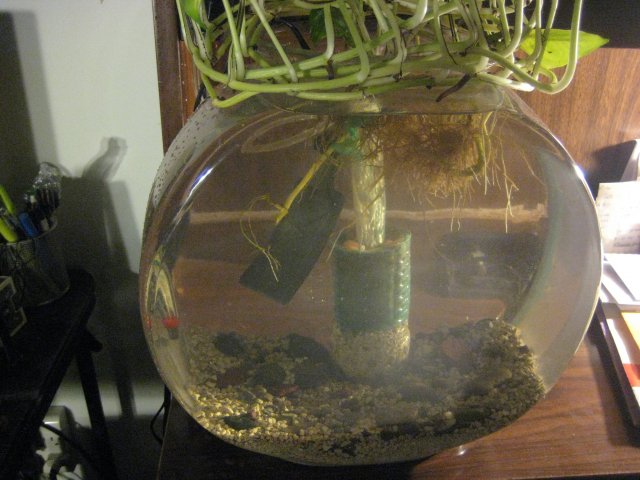
7.) Hook up your air line to an air pump & your all set. Here's one in action inside a 4g bowl I regularly use to house shrimp & extra java moss (it's empty ATM).009.JPG

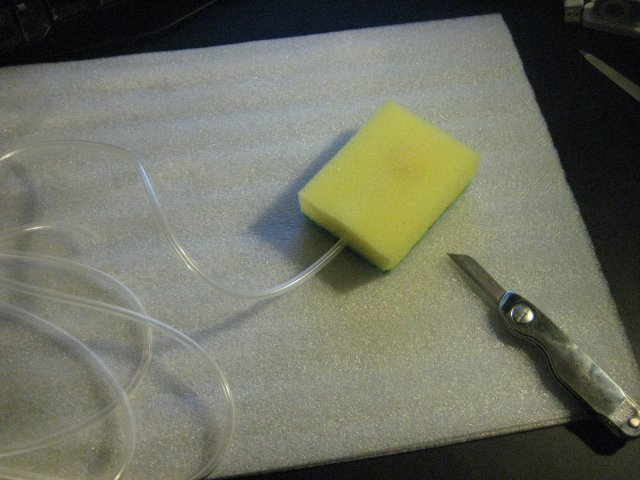
Making a DIY sponge filter is even easier.

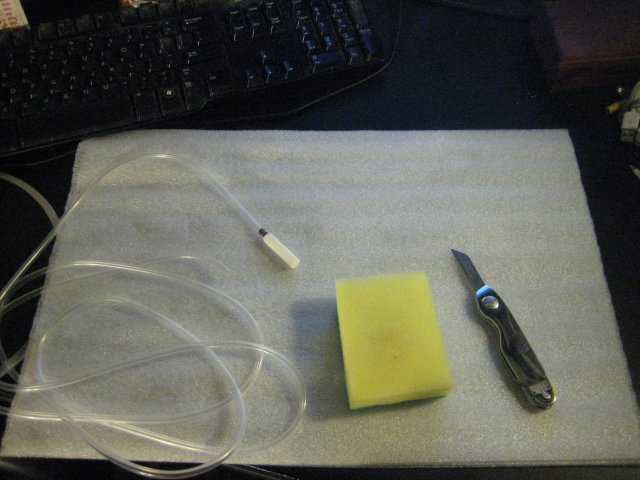
Materials you'll need
will be a polyurethane sponge (NOT Cellulose as it will decay in water & make a mess) that's free of detergents or other cleaning agents, air line tubing, a diffuser or air stone.
012.JPG
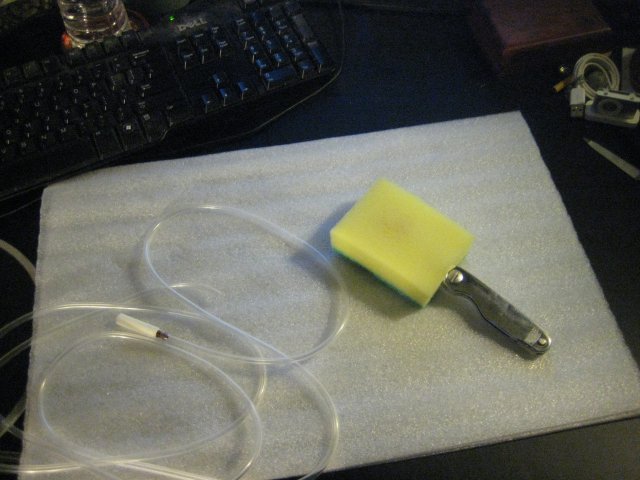
1.) Take your sponge & with a knife, cut into the top center of it. Go down about half way & then stop your incision.
016.JPG
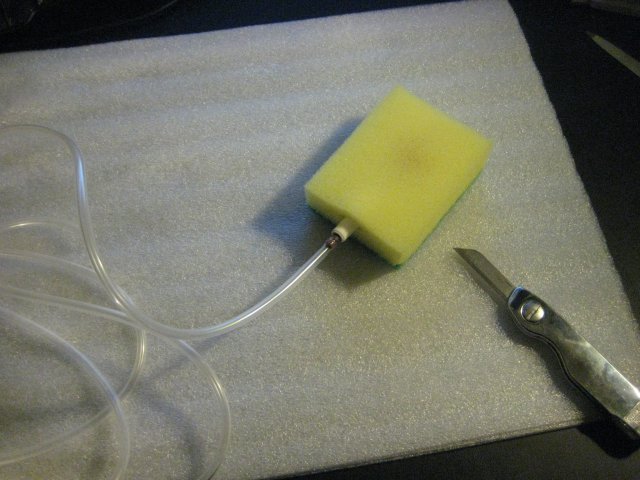
2.) Take your diffuser & attach it to your air line tubing. Once you've attached your diffuser to your air line tubing, insert it into the incision you've cut into your sponge.
014.JPG
3.) You can now hook up your air line tubing to an air pump & your all set.
015.JPG

Either one of these will provide adequate filtration for a 2.5g tank housing two spawning tetras. They will also support adequate bb for bio-filtration as long as you provide them with some ammonia when you don't have your tetras in there. A few fish flakes once or twice a week should provide enough ammonia for your bio-filter.

Yeah both are sin ugly but the objective here is utility & not looks.

Good Luck!

001.JPG 002.JPG 003.JPG 004.JPG 005.JPG 006.JPG 007.JPG 008.JPG 009.JPG 012.JPG 016.JPG 014.JPG 015.JPG
 
Hey, OMG thanks all those were great responses

I remember now from when I was little and I had some goldfish that had ammonia burn and had black marks on them, my little glowlight does have a darker line down his back. Back before I knew anything about aquariums.

So I am going to assume it was an ammonia spike like you all said

However he is still alive, but has yet to get off the bottom, he is in a soft breeder net, breathing more regularly now.

I would assume there is very little I can do to treat ammonia burn?
 
Hey, OMG thanks all those were great responses

I remember now from when I was little and I had some goldfish that had ammonia burn and had black marks on them, my little glowlight does have a darker line down his back. Back before I knew anything about aquariums.

So I am going to assume it was an ammonia spike like you all said

However he is still alive, but has yet to get off the bottom, he is in a soft breeder net, breathing more regularly now.

I would assume there is very little I can do to treat ammonia burn?

No problem. I'm glad he is still alive.

A breeder net is perfect to keep him off of the bottom (that should help him breathe more regularly). As for the ammonia burn, sorry but I'm not really sure how to advise you on how to treat that.

I know that salt (in specific quantities) helps heal a lot of wounds in fish (i.e. torn fins, abrasions etc), but I'm not sure if it would help with ammonia burn or if it would just stress the poor thing out further. What I can definitely suggest is that you continue to keep him elevated until he shows that he'll no longer sink to the bottom & make sure that the water quality is excellent (since an excess of ammonia is what probably caused this to begin with).

If I were you, I'd start a new thread on the forums & title it "Need Advice Treating Ammonia Burn" & give a little back ground as to how your fish got ammonia burn. I am also interested to see what others with more experience treating this would suggest.
 
That's a good idea, I would assume then that he will not be a good stock for my breeding attempts?

Not necessarily. If he makes a full recovery I don't see why you couldn't keep using him for breeding (if you wanted to). As long as the injury hasn't impeded his ability not fertilize eggs I don't see why he wouldn't be good stock.

It's not like their is something genetically wrong with him, it's just an injury he incurred. Heck if he surverys & recovers, I'd say that's a testament to the quality of his stock, wouldn't you?
 
AquariaCentral.com