

Yes i actaully am not only would it still be a monster tank, 250 gallons still when it is half full, but i could also incorporate some land and maybe have something amphibious(sp.)
220g paladarium
- Thread starter KenH
- Start date
You are using an out of date browser. It may not display this or other websites correctly.
You should upgrade or use an alternative browser.
You should upgrade or use an alternative browser.


Construction notes
Here are some construction notes and pictures that others may find useful if considering a similar kind of project.
This system is somewhat unique in that the land portion consists entirely of vertical wall construction without any real flat land area. This was done to maximize the amount of water area since it was the focal point of this tank. I also did not want to mess with keeping a sealed land section dry on this large of a tank in case a leak between the land and water area should develop. That is a problem I had on my small 20 gallon paladarium I had setup. The downside is that there is not really any flat land area, so it limits options if interested in keeping land animals. Certainly be possible to use the same basic construction but add some shelf sections to create land area.
Basic Configuration:
The setup uses a 220 gallon acrylic display tank on an oak aquarium stand. Dimensions are 72”x30”x24” high. The water portion of the tank is 11” deep and the land portion occupies the other 13” of vertical tank height. A taller tank would have been great, but I had to work with what I had. Inside the stand is a 50 gallon glass tank which serves as a sump. Water from the overflow in the display tank flows down to the sump where the water is filtered and heated, then pumped back up where it reenters the main display tank in the form of a waterfall. Lighting is via two large 400W metal halide lights in a light hood. Humidity and watering is controlled via a misting system as well as the large water area. Two fans provide some cross directional air flow through the tank to provide adequate ventilation to prevent mold and fogging of the glass.
Tank Modifications:
The tank is made out of ½” acrylic. As with most acrylic aquariums, the top had very large support pieces around the perimeter and across the center of the tank to support the great weight of the water it normally holds. Since the tank will now only hold about 40% of the normal amount of water, the forces it will see are much smaller and it was safe to remove some of the extra acrylic. This was important to me for easier access to the tank. A router with ¼” straight bit was used along with some simple wood strips and clamps to act as guides to cut the acrylic supports down from 6” to about 3” in width and to narrow the center brace. The back support lip of the tank was left intact.
A small hole was drilled in the top back corners to insert 1/4” ID water return lines to improve water circulation in the ends of the tank over what the waterfall alone provided. A large ¾” hole was drilled near the top of the overflow box to provide the return for the water from the sump to the waterfall. In addition, the existing overflow box was drilled out on the left side to provide an overflow at the desired new water level which was approximately 11” from the bottom of the tank. The overflow is important in that it provides a consistent water depth in the display tank and removes any surface debris or film that might form. A stainless steel screen mesh was used to prevent fish from going over the overflow, but has not been 100% effective and I do occasionally have to rescue fish out of the filter sock in the sump. This is an area that I should have done more live testing with water in the system before I nailed things down. It would have been easy to come up with a better system at that point, but once I had everything installed it was very hard to change this feature.
After the cutting and drilling was completed, the tank was polished using Novus polish #1,2 and 3. Though not perfect, it restored 90% of the appearance of the tank. The tank could have been brought back to an almost a like-new condition, but would have required considerably more effort.
Here are some construction notes and pictures that others may find useful if considering a similar kind of project.
This system is somewhat unique in that the land portion consists entirely of vertical wall construction without any real flat land area. This was done to maximize the amount of water area since it was the focal point of this tank. I also did not want to mess with keeping a sealed land section dry on this large of a tank in case a leak between the land and water area should develop. That is a problem I had on my small 20 gallon paladarium I had setup. The downside is that there is not really any flat land area, so it limits options if interested in keeping land animals. Certainly be possible to use the same basic construction but add some shelf sections to create land area.
Basic Configuration:
The setup uses a 220 gallon acrylic display tank on an oak aquarium stand. Dimensions are 72”x30”x24” high. The water portion of the tank is 11” deep and the land portion occupies the other 13” of vertical tank height. A taller tank would have been great, but I had to work with what I had. Inside the stand is a 50 gallon glass tank which serves as a sump. Water from the overflow in the display tank flows down to the sump where the water is filtered and heated, then pumped back up where it reenters the main display tank in the form of a waterfall. Lighting is via two large 400W metal halide lights in a light hood. Humidity and watering is controlled via a misting system as well as the large water area. Two fans provide some cross directional air flow through the tank to provide adequate ventilation to prevent mold and fogging of the glass.
Tank Modifications:
The tank is made out of ½” acrylic. As with most acrylic aquariums, the top had very large support pieces around the perimeter and across the center of the tank to support the great weight of the water it normally holds. Since the tank will now only hold about 40% of the normal amount of water, the forces it will see are much smaller and it was safe to remove some of the extra acrylic. This was important to me for easier access to the tank. A router with ¼” straight bit was used along with some simple wood strips and clamps to act as guides to cut the acrylic supports down from 6” to about 3” in width and to narrow the center brace. The back support lip of the tank was left intact.
A small hole was drilled in the top back corners to insert 1/4” ID water return lines to improve water circulation in the ends of the tank over what the waterfall alone provided. A large ¾” hole was drilled near the top of the overflow box to provide the return for the water from the sump to the waterfall. In addition, the existing overflow box was drilled out on the left side to provide an overflow at the desired new water level which was approximately 11” from the bottom of the tank. The overflow is important in that it provides a consistent water depth in the display tank and removes any surface debris or film that might form. A stainless steel screen mesh was used to prevent fish from going over the overflow, but has not been 100% effective and I do occasionally have to rescue fish out of the filter sock in the sump. This is an area that I should have done more live testing with water in the system before I nailed things down. It would have been easy to come up with a better system at that point, but once I had everything installed it was very hard to change this feature.
After the cutting and drilling was completed, the tank was polished using Novus polish #1,2 and 3. Though not perfect, it restored 90% of the appearance of the tank. The tank could have been brought back to an almost a like-new condition, but would have required considerably more effort.
Constructing the backdrops
Backdrops:
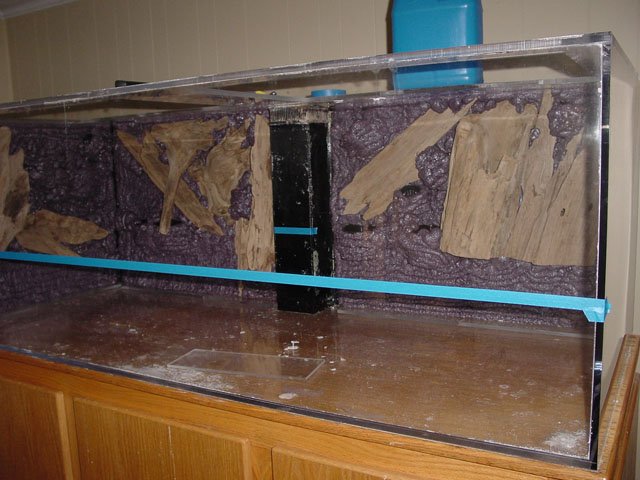
Since the tank is rather large, I decided to build the back drops as separate removable pieces rather than construct the backdrop directly in the tank as is normally done on smaller systems. This made it easy to construct them outside the tank with good access and then reinstall them once completed. Since the tank has a center overflow box, I built the backdrop in three sections. One for each half of the back wall and one for the left end of the tank. That left the front and right end for viewing. The process used for backdrop construction was spray foam over an eggcrate substrate.
Basic backdrop substrate construction:
I used eggcratewhich I cut to size for the 3 partitions. The eggcrate was cut several inches smaller on the sides to allow for some foam overhang and so I could get them through the top openings of the tank. The vertical was designed to be a snug fit for the finished assemblies so that they would stay in place and be self supporting.
Aluminum U-channels were RTV’d to the top of the eggcrate sections to help strengthen the top of the sections. The eggcrate was then set on ¼” thick acrylic scrap pieces that I had and glued in place using Weldon16. The acrylic serves to strengthen the bottom of the sections and provides a ‘foot’ to help stabilize the assemblies which will be covered by the sand in later steps.
Building the backdrops:
The backdrops are constructed over the eggcrate material using wood, plant pots and spray foam to fill in between.
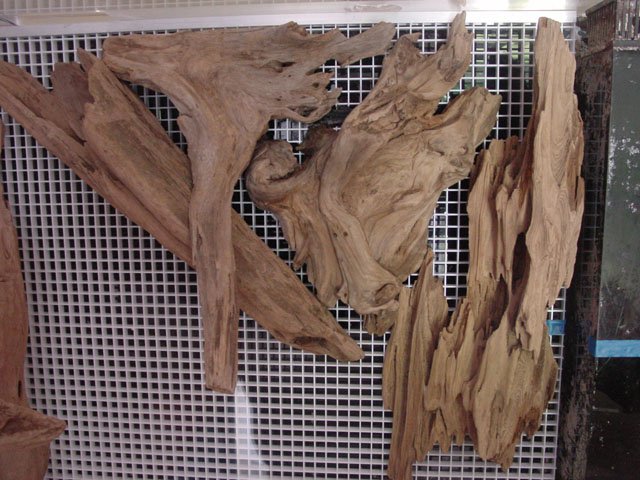
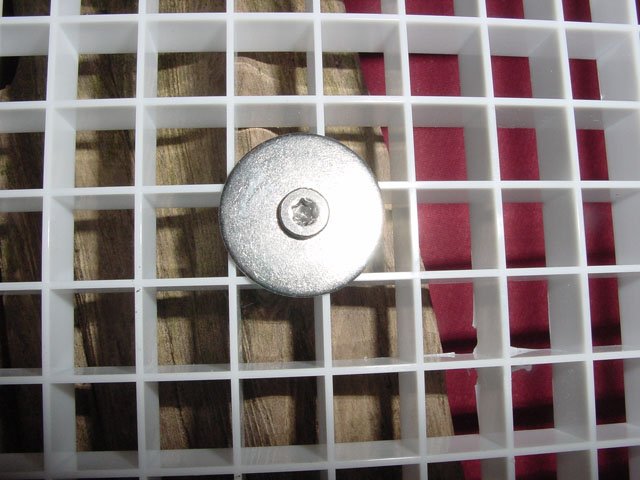
First Cypress wood was fastened to the eggcrate using stainless steel screws and washers. Cypress is good for this application since it is very light and can handle wet environments well.
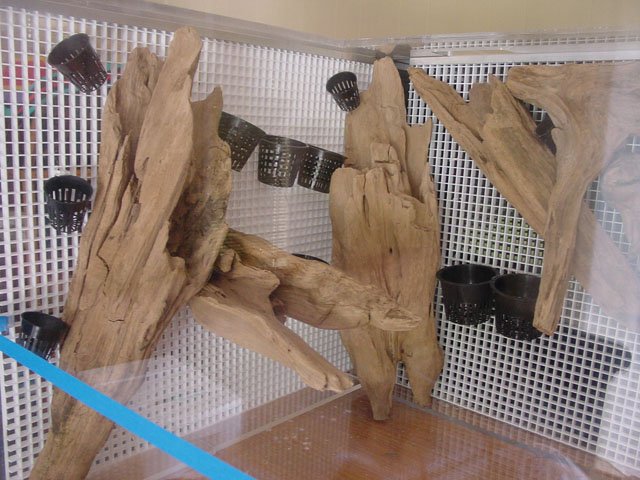
Net plant pots in 2”, 3” and 4” sizes were then put in position and tacked in place with hot melt glue.
Once the basic elements were in place, it was important to check the fit of the pieces into the tank. In this case, several pots had to be moved where the two pieces met in the corner. It is easy to make these corrections now, but not easy after the next step!
Backdrops:
Since the tank is rather large, I decided to build the back drops as separate removable pieces rather than construct the backdrop directly in the tank as is normally done on smaller systems. This made it easy to construct them outside the tank with good access and then reinstall them once completed. Since the tank has a center overflow box, I built the backdrop in three sections. One for each half of the back wall and one for the left end of the tank. That left the front and right end for viewing. The process used for backdrop construction was spray foam over an eggcrate substrate.
Basic backdrop substrate construction:
I used eggcratewhich I cut to size for the 3 partitions. The eggcrate was cut several inches smaller on the sides to allow for some foam overhang and so I could get them through the top openings of the tank. The vertical was designed to be a snug fit for the finished assemblies so that they would stay in place and be self supporting.
Aluminum U-channels were RTV’d to the top of the eggcrate sections to help strengthen the top of the sections. The eggcrate was then set on ¼” thick acrylic scrap pieces that I had and glued in place using Weldon16. The acrylic serves to strengthen the bottom of the sections and provides a ‘foot’ to help stabilize the assemblies which will be covered by the sand in later steps.
Building the backdrops:
The backdrops are constructed over the eggcrate material using wood, plant pots and spray foam to fill in between.
First Cypress wood was fastened to the eggcrate using stainless steel screws and washers. Cypress is good for this application since it is very light and can handle wet environments well.
Net plant pots in 2”, 3” and 4” sizes were then put in position and tacked in place with hot melt glue.
Once the basic elements were in place, it was important to check the fit of the pieces into the tank. In this case, several pots had to be moved where the two pieces met in the corner. It is easy to make these corrections now, but not easy after the next step!
Foaming and covering the backdrops
The backdrops were placed on their backs over wax paper to prevent the foam from adhering to something it shouldn’t.
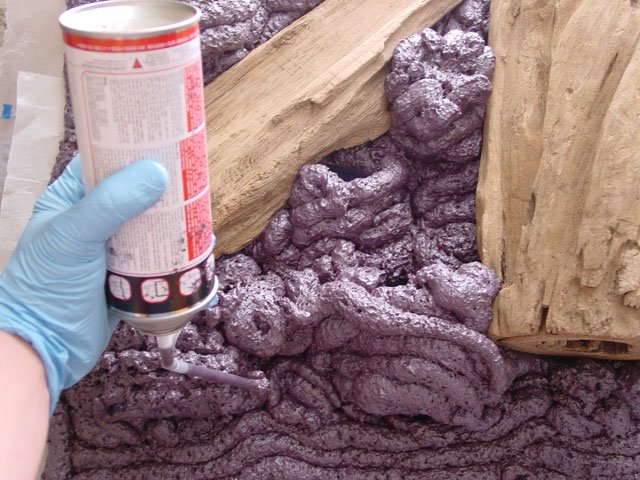
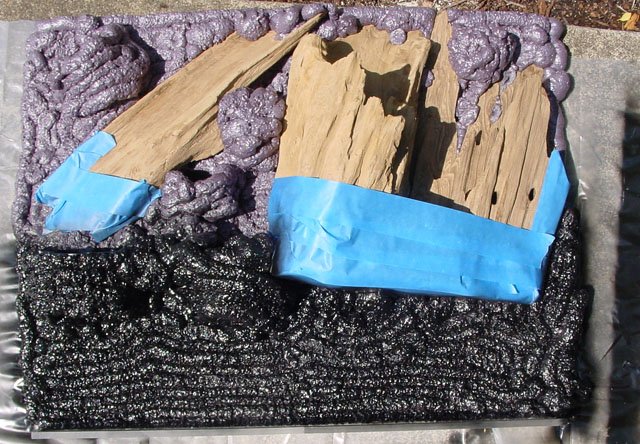
Black spray foam was then added to the background to build up the area between the wood pieces and to cover the plant pots. (Note: it is important to wear gloves when applying the foam. While not harmful, foam that gets on your hands only comes off by using abrasive measures!). The foam is not a high expansion foam, but it still expands a fair amount, so it is applied carefully in a couple of layers to get everything covered. Squirting some of the foam down into the eggrate with the nozzel helps to ensure that it flows around it a little and grabs onto the backing. Extra foam was placed along the edges of the eggcrate to hide them from view and to help fill most of the gaps between the background pieces. When spraying around the pots, some gaps were left at the bottom to allow for drainage. When using eggcrate as done here, the backside of the pot generally has drainage through the eggcrate material as well.
When the foam has skinned over in 15 minutes or so, it is possible to press it down in spots to reconture it if desired. The foam cures by contact with moisture in the air. It may take a day or two for the foam to fully cure. Sometimes pockets may form that don’t cure well and it is possible to shove a nail or similar object into those areas of the foam. This is especially noticeable when applying the foam to glass or acrylic surfaces where you can see the back surface of the foam. The wet foam inside will expand out through the opening that was created and allow it to cure. Excess foam can be trimmed off with a sharp serrated knife after it has cured if desired.
Again, the backdrops were placed back into the tank and the fit checked. Excess foam on the edges and top was removed easily with a serrated knife.
Coating the backdrops:
The black foam has a fairly attractive appearance even when not coated. however, none of the spray foams are fully UV stabilized and so it is helpful to provide a protective covering on the foam both for looks and to protect the raw foam from any UV which may deteriorate it over time.
The portion of the foam that is to be submerged was protected with a coat of black Crylon plastic paint. This type of paint sticks well to the foam without dissolving it like some paints would and has proven harmess to fish and animals once cured. It seems to last very well even in underwater use. Other colors could have been mixed in for a more natural looking finish, but since this tank is very deep front to back with plants and wood in front of it, the backdrop will not be very visible and so black works OK. There is definitely an opportunity to get creative with the paint in this area. The wood was masked off in the painted areas to keep them out of harms way.
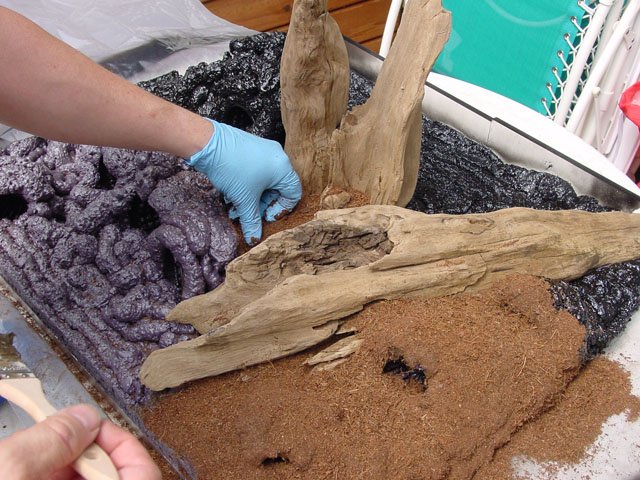
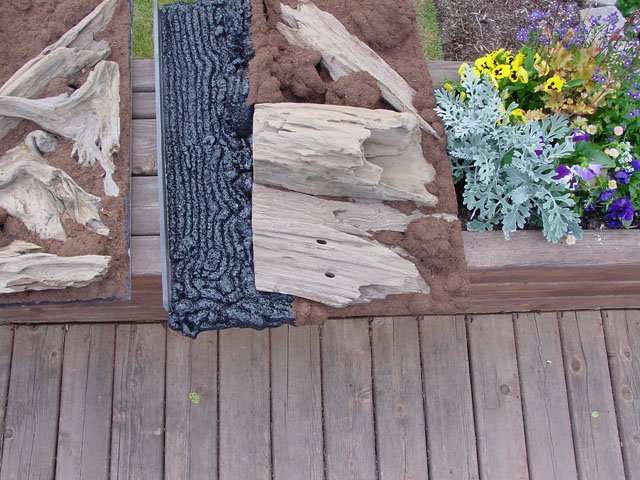
The portion of the foam that is above the water was coated using coire, which is made from ground coconut husks, embedded in RTV. Coire is a very stable and rot resistant organic material which has a long life in this application. The coire is available in brick form and typically sold as bedding material in pet stores. These bricks are reconstituted in water which causes them to expand to several times their normal size. Once expanded, you now have wet coire and you need dry coire to complete the next step. If you have time and sun, you can spread it out in the sun to dry. If in a hurry or don’t have any sun, you can dry it in the oven in batches on a baking dish at 250-300 degrees, stirring occasionally.
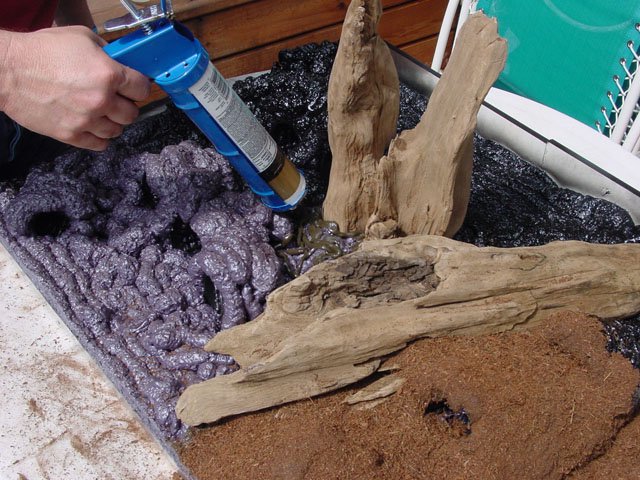
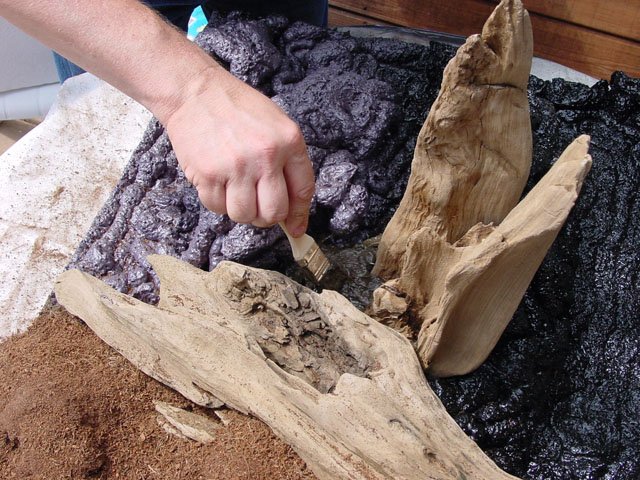
The RTV used here is GE Silicon II in Bronze color, though tan and black colors can also work very well. The RTV is applied by squeezing it onto the foam and then spreading it with a stiff paint brush. Here I am using a brush made by buying a cheap paint brush and cutting the bristles so that they are shorter and stiffer. The RTV is spread in small sections at a time since it skins over fairly quickly and then coire is sprinkled over the area and pressed into the RTV. Plenty of coire is applied to ensure good coverage. The extra will be removed later once the RTV cures.
Once the entire piece was covered in coire, it was allowed to dry overnight. The extra coire was then dumped off and the piece inspected for any missed areas. Those areas got a quick squirt of RTV which was brushed in and a little extra coire added to it.
After another drying period, the piece is once again turned over and tapped to remove the excess coire. A vacuum cleaner with a hose can be used to suck off any remaining loose bits if desired or it can be hosed off and left to dry. Coire that is below the water line will tend to leach tannins and tint the water for a time, so I tried to minimize the amount below the waterline.
The backdrops were placed on their backs over wax paper to prevent the foam from adhering to something it shouldn’t.
Black spray foam was then added to the background to build up the area between the wood pieces and to cover the plant pots. (Note: it is important to wear gloves when applying the foam. While not harmful, foam that gets on your hands only comes off by using abrasive measures!). The foam is not a high expansion foam, but it still expands a fair amount, so it is applied carefully in a couple of layers to get everything covered. Squirting some of the foam down into the eggrate with the nozzel helps to ensure that it flows around it a little and grabs onto the backing. Extra foam was placed along the edges of the eggcrate to hide them from view and to help fill most of the gaps between the background pieces. When spraying around the pots, some gaps were left at the bottom to allow for drainage. When using eggcrate as done here, the backside of the pot generally has drainage through the eggcrate material as well.
When the foam has skinned over in 15 minutes or so, it is possible to press it down in spots to reconture it if desired. The foam cures by contact with moisture in the air. It may take a day or two for the foam to fully cure. Sometimes pockets may form that don’t cure well and it is possible to shove a nail or similar object into those areas of the foam. This is especially noticeable when applying the foam to glass or acrylic surfaces where you can see the back surface of the foam. The wet foam inside will expand out through the opening that was created and allow it to cure. Excess foam can be trimmed off with a sharp serrated knife after it has cured if desired.
Again, the backdrops were placed back into the tank and the fit checked. Excess foam on the edges and top was removed easily with a serrated knife.
Coating the backdrops:
The black foam has a fairly attractive appearance even when not coated. however, none of the spray foams are fully UV stabilized and so it is helpful to provide a protective covering on the foam both for looks and to protect the raw foam from any UV which may deteriorate it over time.
The portion of the foam that is to be submerged was protected with a coat of black Crylon plastic paint. This type of paint sticks well to the foam without dissolving it like some paints would and has proven harmess to fish and animals once cured. It seems to last very well even in underwater use. Other colors could have been mixed in for a more natural looking finish, but since this tank is very deep front to back with plants and wood in front of it, the backdrop will not be very visible and so black works OK. There is definitely an opportunity to get creative with the paint in this area. The wood was masked off in the painted areas to keep them out of harms way.
The portion of the foam that is above the water was coated using coire, which is made from ground coconut husks, embedded in RTV. Coire is a very stable and rot resistant organic material which has a long life in this application. The coire is available in brick form and typically sold as bedding material in pet stores. These bricks are reconstituted in water which causes them to expand to several times their normal size. Once expanded, you now have wet coire and you need dry coire to complete the next step. If you have time and sun, you can spread it out in the sun to dry. If in a hurry or don’t have any sun, you can dry it in the oven in batches on a baking dish at 250-300 degrees, stirring occasionally.
The RTV used here is GE Silicon II in Bronze color, though tan and black colors can also work very well. The RTV is applied by squeezing it onto the foam and then spreading it with a stiff paint brush. Here I am using a brush made by buying a cheap paint brush and cutting the bristles so that they are shorter and stiffer. The RTV is spread in small sections at a time since it skins over fairly quickly and then coire is sprinkled over the area and pressed into the RTV. Plenty of coire is applied to ensure good coverage. The extra will be removed later once the RTV cures.
Once the entire piece was covered in coire, it was allowed to dry overnight. The extra coire was then dumped off and the piece inspected for any missed areas. Those areas got a quick squirt of RTV which was brushed in and a little extra coire added to it.
After another drying period, the piece is once again turned over and tapped to remove the excess coire. A vacuum cleaner with a hose can be used to suck off any remaining loose bits if desired or it can be hosed off and left to dry. Coire that is below the water line will tend to leach tannins and tint the water for a time, so I tried to minimize the amount below the waterline.

Constructing the final display and waterfall
Constructing the final display
The backdrops were put back into the tank for the final time. With the backdrops done, it was now possible to build the final display.
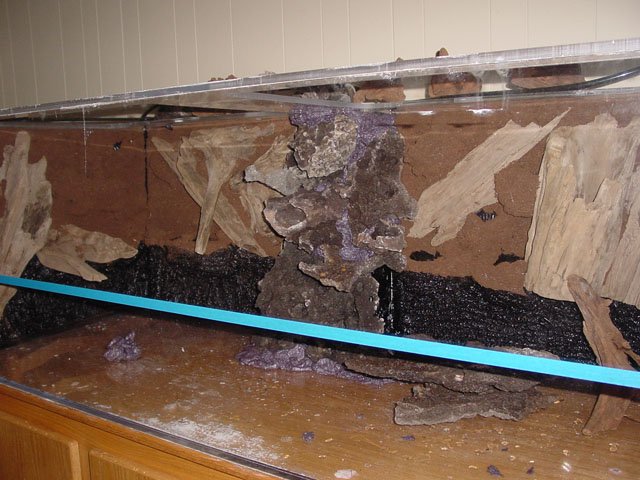
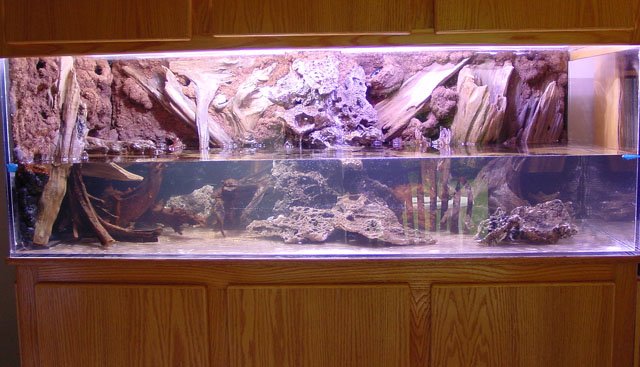
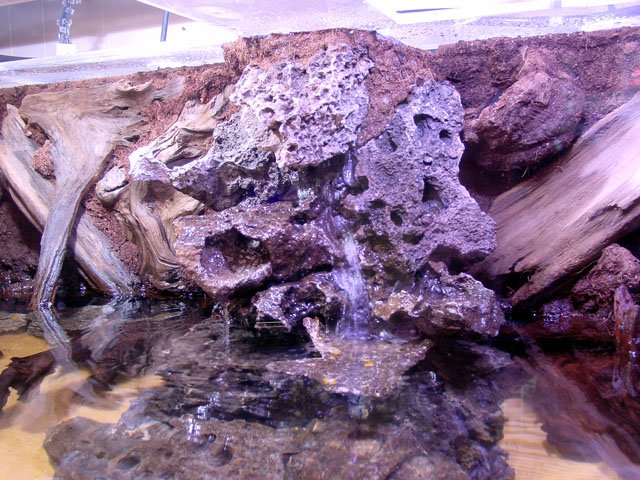
First order of business was to build the waterfall. The ½” water return line was plumbed up from the sump to the overflow box. A ¾” strainer was added to the outlet side which serves to break up the force of the water from the pump and allow it to spill out more naturally. The waterfall itself is constructed of lace rock which is a volcanic rock with many interesting nooks and crannies which give it great character. The rock was stacked to give a pleasing display and then the black spray foam was applied at the base and in the nooks and crannies to stabilize the pile of rocks into one piece and ensure that the water cascaded over and not under the rocks. At the top, the water return line was well hidden from normal viewing by careful placement of the rocks.
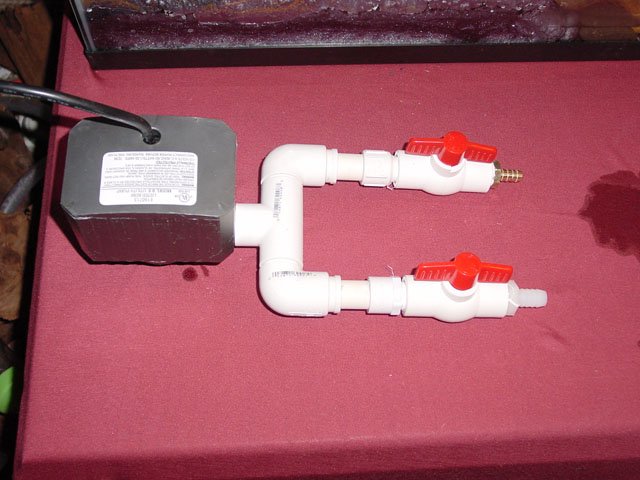
Separate ¼” return lines were run to each back corner of the display and hidden by the backdrop. These returns ensure adequate water circulation is maintained throughout the water area to prevent cold or stagnant areas since the waterfall and overflow are both in the middle of the tank. Both the waterfall and the two ¼” return lines were run off of separate ball valves for flow control since I am using a MAG1200 pump that I had laying around which could easily overpower the waterfall.
Additional lace rock was then added at the base of the waterfall and along the backdrop to tie those areas together visually. The sump was filled with water and the pumps turned on to check out the waterfall operation. Everything looked pretty good on this setup, but now would be the time to try to make any tweaks that may be desired for proper water fall performance.
Constructing the final display
The backdrops were put back into the tank for the final time. With the backdrops done, it was now possible to build the final display.
First order of business was to build the waterfall. The ½” water return line was plumbed up from the sump to the overflow box. A ¾” strainer was added to the outlet side which serves to break up the force of the water from the pump and allow it to spill out more naturally. The waterfall itself is constructed of lace rock which is a volcanic rock with many interesting nooks and crannies which give it great character. The rock was stacked to give a pleasing display and then the black spray foam was applied at the base and in the nooks and crannies to stabilize the pile of rocks into one piece and ensure that the water cascaded over and not under the rocks. At the top, the water return line was well hidden from normal viewing by careful placement of the rocks.
Separate ¼” return lines were run to each back corner of the display and hidden by the backdrop. These returns ensure adequate water circulation is maintained throughout the water area to prevent cold or stagnant areas since the waterfall and overflow are both in the middle of the tank. Both the waterfall and the two ¼” return lines were run off of separate ball valves for flow control since I am using a MAG1200 pump that I had laying around which could easily overpower the waterfall.
Additional lace rock was then added at the base of the waterfall and along the backdrop to tie those areas together visually. The sump was filled with water and the pumps turned on to check out the waterfall operation. Everything looked pretty good on this setup, but now would be the time to try to make any tweaks that may be desired for proper water fall performance.
Planting the backdrops
Planting the backdrops.
Because planting land plants involves some dirt, it was easiest to get that done before the tank had gravel and stuff added. The water in the tank was siphoned down so that the marginal plant pots (where the plant roots are in the water) are out of the water for less messy planting. Tropical plants were simply removed from their pots and the roots trimmed as necessary to fit into the new planting pot in the backdrop. Attention should be paid to whether the plants like to grow trailing down or have more upright growth to give them room to grow. Some plants like wet roots and others do not. Here, I used plants such as red melon swords, miniature acornus and miniature umbrella palms in the marginal pots. Plants such as bromeliads and Orchids were mounted to the wood or foam backdrop directly without the use of dirt.
After the planting is done, the water area was siphoned out to remove as much errant dirt as possible.
Next Malaysian driftwood was added to the water area. Malaysian driftwood is naturally heavy and sinks in water. This is important unless you want to mess with mounting slate to pieces of wood to get them to sink or soaking the wood for long periods of time to try to get them waterlogged enough to sink. Malaysian driftwood won’t rot or leach excessive tannins(compounds that darken the water) and comes in many interesting shapes and sizes. The layout used here duplicated the look of roots entering the tank on the left side.
With the wood in place, the gravel substrate was added. I used a 1 ½” layer of Seachem Flourite to provide an iron rich substrate for plants. On top of that, another 1 to 1 ½” layer of small 2mm-3mm gravel was added. All material was carefully washed before adding it, though the Flourite is never 100% clean since it is a clay based material. I just shot for getting 75% of the grit washed off. The top layer dressing of normal gravel helps to seal in any remaining grit as well.
The tank was then refilled with water and allowed to run for a week or so. The coire that is below the waterline and the new wood will tend to darken the water. It is good to allow this to run for a while and drain and replace the water a couple of times to leach as much of this out as possible before planting the water section. For this reason, it is desireable to minimize the amount of coire below the waterline as much as possible unless you want the look of dark water for a particular biop you are constructing.
Can't seem to find any pics of this stage :irked:
Planting the backdrops.
Because planting land plants involves some dirt, it was easiest to get that done before the tank had gravel and stuff added. The water in the tank was siphoned down so that the marginal plant pots (where the plant roots are in the water) are out of the water for less messy planting. Tropical plants were simply removed from their pots and the roots trimmed as necessary to fit into the new planting pot in the backdrop. Attention should be paid to whether the plants like to grow trailing down or have more upright growth to give them room to grow. Some plants like wet roots and others do not. Here, I used plants such as red melon swords, miniature acornus and miniature umbrella palms in the marginal pots. Plants such as bromeliads and Orchids were mounted to the wood or foam backdrop directly without the use of dirt.
After the planting is done, the water area was siphoned out to remove as much errant dirt as possible.
Next Malaysian driftwood was added to the water area. Malaysian driftwood is naturally heavy and sinks in water. This is important unless you want to mess with mounting slate to pieces of wood to get them to sink or soaking the wood for long periods of time to try to get them waterlogged enough to sink. Malaysian driftwood won’t rot or leach excessive tannins(compounds that darken the water) and comes in many interesting shapes and sizes. The layout used here duplicated the look of roots entering the tank on the left side.
With the wood in place, the gravel substrate was added. I used a 1 ½” layer of Seachem Flourite to provide an iron rich substrate for plants. On top of that, another 1 to 1 ½” layer of small 2mm-3mm gravel was added. All material was carefully washed before adding it, though the Flourite is never 100% clean since it is a clay based material. I just shot for getting 75% of the grit washed off. The top layer dressing of normal gravel helps to seal in any remaining grit as well.
The tank was then refilled with water and allowed to run for a week or so. The coire that is below the waterline and the new wood will tend to darken the water. It is good to allow this to run for a while and drain and replace the water a couple of times to leach as much of this out as possible before planting the water section. For this reason, it is desireable to minimize the amount of coire below the waterline as much as possible unless you want the look of dark water for a particular biop you are constructing.
Can't seem to find any pics of this stage :irked:

Installing the support systems
Installing the misting system
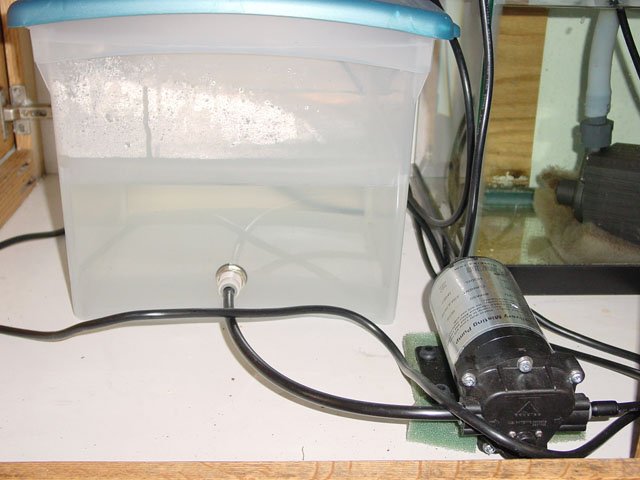
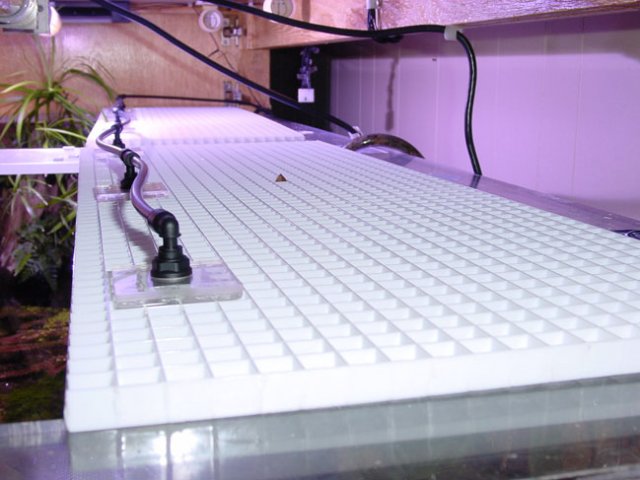
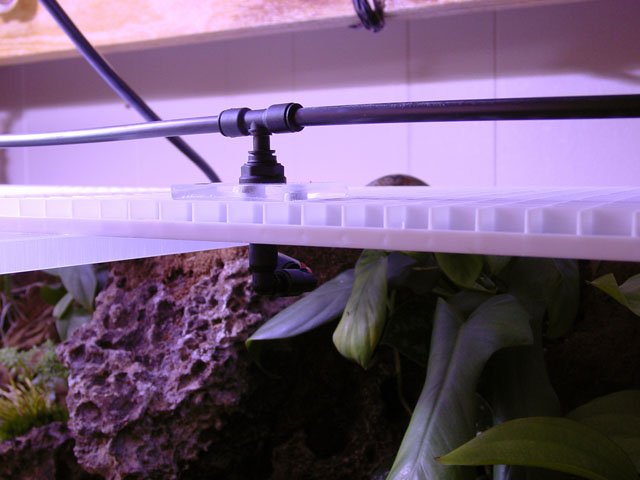
The misting system is a luxury on smaller tanks, but because of the large size of this tank, I considered it a necessity, especially since I wanted it to be as maintenance free as possible. There are 7 fine mist spray nozzles which are mounted to eggcrate which have a section cut out and a small piece of acrylic glued in place. This system has several benefits.
Installing the filter system.
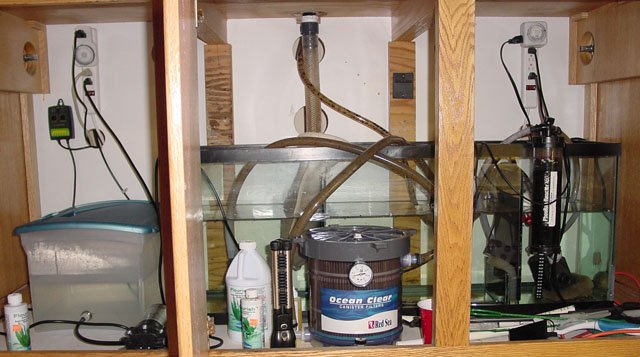
The filter presents a bit of a challenge on a system like this. It must sit level with the sump tank which is only partially filled with water. A normal canister filter may work OK, but there were concerns as to whether the canister would maintain its siphon during power outages since it had to pull the water up out of the sump tank. A good solution for me was to use the Sea Clear filter. This large pleated filter with carbon filled center is fed by a MAG 9.5 pump sitting in the sump. The output of the filter is fed back into sump near the return pump. A 300W submersible heater in the sump keeps the water temperature in the 77 degree range. I don’t think a filter is a necessity on a tank like this, but figured it wouldn’t hurt.
Lighting.
The lighting system is composed of two 400W 10K metal halide lamps. These are sort of unusual for this application, but were left over from the saltwater reef tank setup and were reused. The concern with them is primarily the amount of light and heat that they can put out. As noted above, the eggcrate material helps to shield some of the light from the moderate light loving plants on the backgrounds. The lights come on in the following sequence. Left on at 10, off at 8PM. Right comes on at 3PM and off at 11PM. This only has both lights on for 5 hours a day which simulates mid day conditions. With one light running, the tank is somewhat unevenly lit, but still looks good. High powered fluorescent lighting would probably be a better lighting selection if starting from scratch.
Ventilation:
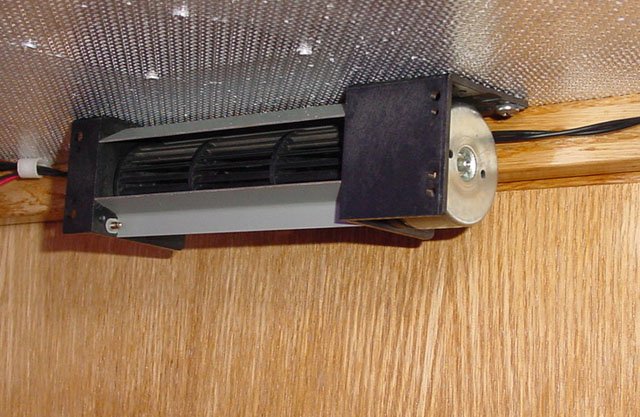
Ventilation is important to provide some cooling from the lamps, but also to prevent stagnant air and excessively humid conditions where mold or rot can take hold. The water feature and misting system work to keep moisture and humidity up while the lights and fans work to pull it back out in a kind of dance. A squirrel cage fan is mounted at either end of the light hood and run off a recycled wavemaker. This device turns one fan on for about 40 minutes, then turns it off and turns on the other fan for 40 minutes and then repeats the cycle. The fans are run during the times that the lights are on and turned off at night.
Installing the misting system
The misting system is a luxury on smaller tanks, but because of the large size of this tank, I considered it a necessity, especially since I wanted it to be as maintenance free as possible. There are 7 fine mist spray nozzles which are mounted to eggcrate which have a section cut out and a small piece of acrylic glued in place. This system has several benefits.
- The eggcrate allows the nozzles to be positioned back from the backdrops far enough for good spray coverage
- The eggcrate provides good air circulation while still providing a support for the misters.
- The eggcrate helps to shield the backdrop areas from some of the high powered metal halide lighting which is good for the bromeliads and similar moderate light loving plants while allowing most of the light to reach the water plants which are a ways from the lights.
- The eggcrate provides a screen so that when viewing the tank from a sitting position, you are not looking at the ugly inner workings of the hood such as the lights or fans.
Installing the filter system.
The filter presents a bit of a challenge on a system like this. It must sit level with the sump tank which is only partially filled with water. A normal canister filter may work OK, but there were concerns as to whether the canister would maintain its siphon during power outages since it had to pull the water up out of the sump tank. A good solution for me was to use the Sea Clear filter. This large pleated filter with carbon filled center is fed by a MAG 9.5 pump sitting in the sump. The output of the filter is fed back into sump near the return pump. A 300W submersible heater in the sump keeps the water temperature in the 77 degree range. I don’t think a filter is a necessity on a tank like this, but figured it wouldn’t hurt.
Lighting.
The lighting system is composed of two 400W 10K metal halide lamps. These are sort of unusual for this application, but were left over from the saltwater reef tank setup and were reused. The concern with them is primarily the amount of light and heat that they can put out. As noted above, the eggcrate material helps to shield some of the light from the moderate light loving plants on the backgrounds. The lights come on in the following sequence. Left on at 10, off at 8PM. Right comes on at 3PM and off at 11PM. This only has both lights on for 5 hours a day which simulates mid day conditions. With one light running, the tank is somewhat unevenly lit, but still looks good. High powered fluorescent lighting would probably be a better lighting selection if starting from scratch.
Ventilation:
Ventilation is important to provide some cooling from the lamps, but also to prevent stagnant air and excessively humid conditions where mold or rot can take hold. The water feature and misting system work to keep moisture and humidity up while the lights and fans work to pull it back out in a kind of dance. A squirrel cage fan is mounted at either end of the light hood and run off a recycled wavemaker. This device turns one fan on for about 40 minutes, then turns it off and turns on the other fan for 40 minutes and then repeats the cycle. The fans are run during the times that the lights are on and turned off at night.
