

GE has two Silicone II Window & Door in Canada (Toronto). One has BIO logo and one doesn't mention. I think they do it on marketing purpose. I choose II becasue it says it is stronger than I.
Building my first styrofoam cement background with some questions.
- Thread starter CatchMoreFish
- Start date
You are using an out of date browser. It may not display this or other websites correctly.
You should upgrade or use an alternative browser.
You should upgrade or use an alternative browser.

After testing cement on a small piece of styrofoam, I started the first big block yesterday. It took about half hour to finish one side. I mixed cement with silica sand at 3:1 ratio. Using a tooth brush, applied a thin layer of cement. Easy job, like brushing teeth. It went very well and I finished the back today. I also sprayed water 3 times. Everything was done according to what I found on 'how to build a 3D background' on the Internet.
Following is the 75G tank I am going to build the rockwall.
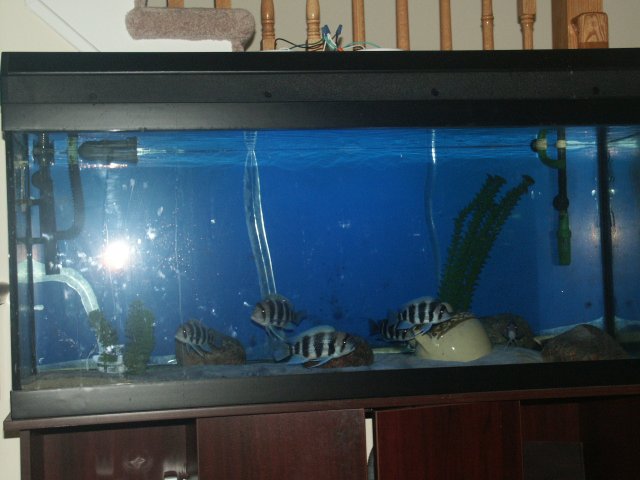


Following is the 75G tank I am going to build the rockwall.

mellowvision
Seafood Lover
In Toronto, Canada, you can find two types of GE Silicon I for Window & Door in blue and red. Red is the one has bio-kill. Besides that, you can aslo find two types of GE Silicon II for Window & Door in blue and red. Red one is the bio-kill.

dont you have to seal this stuff before you put it in the tanks?
paint and chemicals leech out even without water and nibbly fish to help it along.. certainly it would flake and taint the water of an aquarium.
i wouldn't even spray paint this stuff to be honest..
if i needed color i'd dye the wet cement itself with food coloring or something natural.. coffee for example. then coat the whole thing with 100% silicone sealant... and i mean THICK half an inch at least.
i agree with taking the styrofoam out if you can. It's a great way to mold the cement, but its more hassle than it should be to get into the water.use it to make the cement the right shape, then take it out of the back.. if there's still too many nooks and cranny in the back, then put more cement in those places to smooth it out (keep debris from getting stuck there and mucking up the water) and then coat it like crazy with silicone.
marine grade sealant works too, but i like the silicone caulk cuz i have a little more control over it.
paint and chemicals leech out even without water and nibbly fish to help it along.. certainly it would flake and taint the water of an aquarium.
i wouldn't even spray paint this stuff to be honest..
if i needed color i'd dye the wet cement itself with food coloring or something natural.. coffee for example. then coat the whole thing with 100% silicone sealant... and i mean THICK half an inch at least.
i agree with taking the styrofoam out if you can. It's a great way to mold the cement, but its more hassle than it should be to get into the water.use it to make the cement the right shape, then take it out of the back.. if there's still too many nooks and cranny in the back, then put more cement in those places to smooth it out (keep debris from getting stuck there and mucking up the water) and then coat it like crazy with silicone.
marine grade sealant works too, but i like the silicone caulk cuz i have a little more control over it.

dont you have to seal this stuff before you put it in the tanks?
paint and chemicals leech out even without water and nibbly fish to help it along.. certainly it would flake and taint the water of an aquarium.
i wouldn't even spray paint this stuff to be honest..
if i needed color i'd dye the wet cement itself with food coloring or something natural.. coffee for example. then coat the whole thing with 100% silicone sealant... and i mean THICK half an inch at least.
i agree with taking the styrofoam out if you can. It's a great way to mold the cement, but its more hassle than it should be to get into the water.use it to make the cement the right shape, then take it out of the back.. if there's still too many nooks and cranny in the back, then put more cement in those places to smooth it out (keep debris from getting stuck there and mucking up the water) and then coat it like crazy with silicone.
marine grade sealant works too, but i like the silicone caulk cuz i have a little more control over it.
no, marine grade sealant doesnt work, i used some and it flaked off, allowing the paint to get out. as mentioned maybe i didnt mix it right, but it sure didnt work.
Cement by itself doesnt need to be sealed, and it still wouldnt need to be sealed if it was painted with krylon fusion, as that is aquarium safe.
silicone is a pain as well, and may not adhere as well as you might think.
his background should be fine as it is once its dry.
also removing the styrofoam isnt an easy process either, you need acetone to dissolve it..... and how aquarium safe is acetone?

Acetone does evaporate very quickly so as long as it's left out for a day or so the acetone should be gone. I'd be more worried about what toxic chemicals might be formed during the dissolving process itself. What are the resulting compounds from a reaction between acetone and styrofoam?
Haha, I answered a question with a question
Haha, I answered a question with a question
Interestingly, the styrofoam is essentially puffed up polystyrene (like marshmallows are puffed up sugar) so acetone dissolves the polystyrene and releases the air it was puffed up with. When the acetone evaporates it will leave the reduced polystyrene behind. Should be fish safe as I understand both substances... <Insert Standard Disclaimer>
