

diatom & lightng ?'s

xsdbs

AC Members
Oct 16, 2006
823
0
0
I have read a couple times that brown algae can be controlled by less feeding, better water flow and a shorter time period of lighting. my question is on the lighting. how much time is too long for lights to be off and not freak out the corals? would I be better off running with only 1 pr of my t5s instead of the 4 vs leaving the lights off for a day or so?
thanks in advance for your help
 
Well, reducing the lighting is sort of like cheating. You are treating the symptoms, essentially, and not the cause. Silicate reduction is the number one way to be rid of diatoms--even then, you'll still get some (at least initially) from silicates imported from elsewhere. If you have an RO/DI unit, I suggest you look at www.thefilterguys.biz , which has preferential phosphate/silicate adsorption resins. Ideally, you'd want to use these in a 5th or 6th stage, after your initial resin.
 
thank you both for the information. as I have mentioned in a couple other threads that I have posted about the diatom, my tank is 150 gallons and nearly 2 years old. I have the coral life pure flow 24RO unit. I have recently replaced the filters and also had to replace the resin cartridge ( manufacturer issue ). I have about a 3-4" DSB with a 55 gallon sump but using only about 35 gallons to keep from having an overflow onto the floor if I lose electricity. I think that part of my issue is the fact that I used sand that is for sand blasting and have found that it contains some silica. however it has been stated that after time that this should not matter. this sand is about 1/3 - 1/2 of my total sand especially in the sump which is about 4-5" deep. I have read that some diatom is normal in saltwater tanks however the places that this stuff is building up may be from flow even though it seems that I should have enough flow in the tank with my 2 rio 2100's, a korlia 4 ( I have had for about 4 months and like this type of flow vs the rio 2100s )and a fluval fx5 which I am using as a type of closed loop, I have no media in it but I have put 2 packs of algone in 1 of the baskets thinking it would be a good flow placement. I have a pondmaster 26 pump as my return ( 2600 gallons/ hr-- with my run of about 10ft of pvc I est about 1900 G/hr) however thru reading here I have learned hat my return should not be calcuated into my turnover rate. I believe that amphipron has talked about a tunze unit that is fair in price and can also be upgraded to a highe routput. I am thinking about taking out my 2100's and replacing them with either the korlias or the tunzw units while also removing the pondmaster 26, installing it as a closed loop and then perhaps using 1 of the 2100's as a return or something smaller than the PM 26 as I have also read that I need to slow down the water flow so the sump can actually do the filter job that is supposed to be doing.
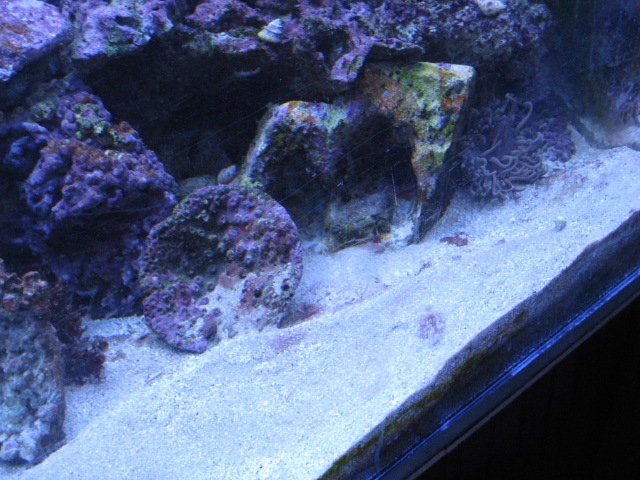
I am looking at just being able to control this a little more till after the first of the year when I can work on it during our unfortunate 1 month ( hopefully not longer ) lay off. below I have included a couple pics so you can get a better look at what I am working with. also you will notice that I have a anenome that has found it's home in a good spot that makes it visible instead of behind rocks, I know there is a need for more flow and I am worried that if I bring more flow there that it may go back behind the rocks again. sorry for being so long winded here and thanks again for your help.
ps. you'll see I also have about 150 lbs of LR

IMG_2136.JPG IMG_2182.JPG IMG_2183.JPG IMG_2184.JPG IMG_2188.JPG
 
What you left out were your nitrate/phosphate levels. To me from those pic it looks like that is not diatoms. Looks like the start of cyano.
 
just to ask more about this cyno or diatom stuff,
why is it only on 1 side of my tank, ( thats why I thought it may be related to flow ) also if it cyno what is a cure for that vs diatom. Thanks :)

The pictures do indeed indicate cyanobacteria. If it seems to be occurring in areas with lower flow, then detritus settling could be acting as a substrate-source of nutrients for them to grow. Try manually removing the patches and then increasing flow to see if that helps.
 
AquariaCentral.com
