

I've finished the most time consuming part of the work for my DIY RUGF; now I just need to arrange the tubing and I have some questions.
I've used the model of this RUGF in deciding the basic design:
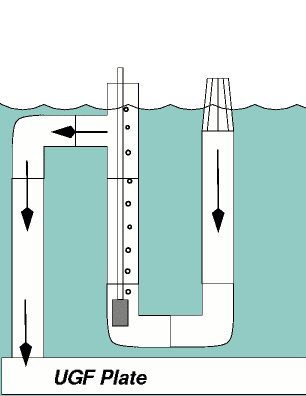
http://www.thekrib.com/Filters/rugf.gif
One exception I'm making is that I'm not going to skim from the top as illustrated in the model. I'm also going to try to prevent getting too much debris under the tray by putting a sponge in the intake, assuming that does not hurt the water flow too much.
What I'd like to know is:
1) What puts the R in the RUGF? What is it about this design that causes the water to flow in the reverse rather than flowing out of the "in"take? I will be using an airstone rather than a powerhead, as in the model.
And on a related note:
2) What lengths of tube will ensure the best flow? Is it best to have the tube sticking up from the grid go all the way to the top, followed by the 90 deg. bend & T, then have the second tube stick all the way back down to the bottom, or can I shorten the second tube and perhaps get better pull in the process? What's the most efficient design (besides just getting a powerhead)?
And regarding substrate:
3) I have read that UGFs require 2-3" of substrate. Is that a minimum range (at least 2-3" of substrate), or is that a minimum/maximum range (no less than 2" and no more than 3" of substrate)?
4) I have also read that UGFs require that you keep your gravel level to allow even flow through it, but I want to slope downward toward the front of the tank. Can I put a sloping layer of larger gravel down, then cover that with a layer of Flourite that is thicker toward the front, therefore having a higher level of gravel in the back, but with more space available for water to flow through, thus evening out the flow? Alright, that's a confusing question, so here's a terrible representation of what I mean, where the O's are the larger gravel and the o's are the flourite.
oooooooooo
OOOOOoooooooooooooo
OOOOOOOOOOooooooooooooooooooo
OOOOOOOOOOOOOOOoooooooooooooooooooo
OOOOOOOOOOOOOOOOOOOOooooooooooooooo
OOOOOOOOOOOOOOOOOOOOOOOOOOooooooooo
Finally, if the above is feasible:
5) Is there any material I can layer between the larger gravel and the flourite that will keep them from getting mixed up when I vacuum? The same door screening I used for my filter tray perhaps?
Thanks!! :read:
I've used the model of this RUGF in deciding the basic design:
http://www.thekrib.com/Filters/rugf.gif
One exception I'm making is that I'm not going to skim from the top as illustrated in the model. I'm also going to try to prevent getting too much debris under the tray by putting a sponge in the intake, assuming that does not hurt the water flow too much.
What I'd like to know is:
1) What puts the R in the RUGF? What is it about this design that causes the water to flow in the reverse rather than flowing out of the "in"take? I will be using an airstone rather than a powerhead, as in the model.
And on a related note:
2) What lengths of tube will ensure the best flow? Is it best to have the tube sticking up from the grid go all the way to the top, followed by the 90 deg. bend & T, then have the second tube stick all the way back down to the bottom, or can I shorten the second tube and perhaps get better pull in the process? What's the most efficient design (besides just getting a powerhead)?
And regarding substrate:
3) I have read that UGFs require 2-3" of substrate. Is that a minimum range (at least 2-3" of substrate), or is that a minimum/maximum range (no less than 2" and no more than 3" of substrate)?
4) I have also read that UGFs require that you keep your gravel level to allow even flow through it, but I want to slope downward toward the front of the tank. Can I put a sloping layer of larger gravel down, then cover that with a layer of Flourite that is thicker toward the front, therefore having a higher level of gravel in the back, but with more space available for water to flow through, thus evening out the flow? Alright, that's a confusing question, so here's a terrible representation of what I mean, where the O's are the larger gravel and the o's are the flourite.
oooooooooo
OOOOOoooooooooooooo
OOOOOOOOOOooooooooooooooooooo
OOOOOOOOOOOOOOOoooooooooooooooooooo
OOOOOOOOOOOOOOOOOOOOooooooooooooooo
OOOOOOOOOOOOOOOOOOOOOOOOOOooooooooo
Finally, if the above is feasible:
5) Is there any material I can layer between the larger gravel and the flourite that will keep them from getting mixed up when I vacuum? The same door screening I used for my filter tray perhaps?
Thanks!! :read:


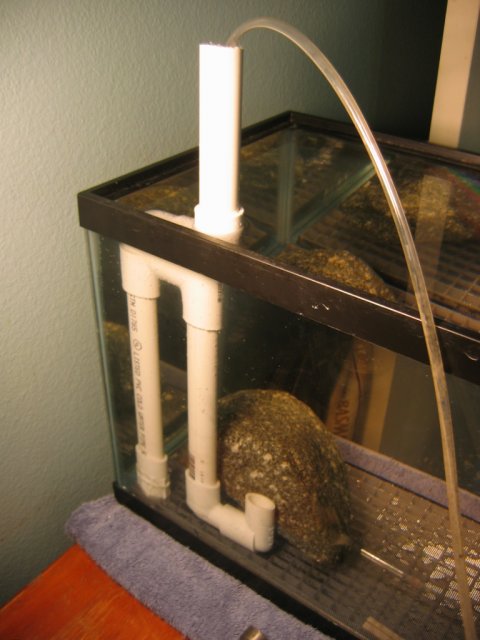
 I'm trying to build my first DIY aquarium project and figuring out the optimal flow that can be achieved with an air pump (that I picked up for $3 and am trying to dream up a use for) is part of the experience and part of the fun.
