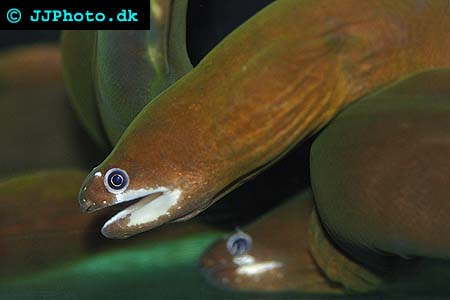
What the heck is this?

i think all morays come into fresh water when it is mating time. i know the very young can live in fresh water then move into brackish and eventually full salt as they age.
Incorrect. Most Morays are reef dwellers and never see FW. The White Cheek or so called Frshwater Moray lives in estuarys and enters FW. I think you have the life cycle confused with the American Eel which is a catadromous fish, living in FW and going into SW to breed.
 
Looks like this:
http://www.aquaticcommunity.com/predatory/freshwatermoray.php

echidna_rhodochilus_1.jpg
 
Not a caecilian (these don't occur in North America in any case). Not an American eel. Not a lamprey. Definitely exotic, or else a marine species somehow trapped in the lake (very unlikely).Swamp eel?

*EDIT* Please contact your DNR! Introduced exotics can be bad news, and the sooner they know about this the sooner something can be done! We don't need another snakehead or sea lamprey destroying our native fishes.

I posted a link to this thread over at NANFA (I hope you don't mind, Nomad, but I thought it was important). A better ichthyologist than I has confirmed my guess of synbranchid eel, though he didn't provide any further info. I know at least one synbranchid species is established in the canals of south Florida and seems to be doing little harm there, but still: better safe than sorry!

It looks like a synbranchid "swamp eel," possibly Monopterus albus, a wide-ranging Asian species. It has become established in Florida, Hawaii, and Georgia (where it has exhibited some tolerance of freezing conditions). Your friend's finding in New Jersey would be a first for the state, and -- as far as I'm aware -- the northernmost report of this species anywhere in the United States. Probable means of introduction: live food fish or aquarium trade.


I suggest you contact relevant authorities -- I'm not personally familiar with the procedure, but the NAS site I linked may have additional information. Sorry for the rushed post -- I'm in a hurry at the moment.


Looks like this to me. I think a couple of people above said it already.

Synbranchidae (Swamp-eels)

http://www.fishbase.org/Summary/SpeciesSummary.php?id=4663

Is there a reason why this is still being discussed? Not to mention it is well over a year old...
 
Is there a reason why this is still being discussed? Not to mention it is well over a year old...

I would like to think that some subjects are meritous of a life of thier own

I am glad this old thread was reactivated as I would not have seen it otherwise
 
Being that the post is old, I think the pertinent question is; did these make it through the winter? Nomad, has your friend been back to this pond in '09?
 
AquariaCentral.com