View Full Version : Rockfish
cdawson
01-15-2003, 12:19 AM
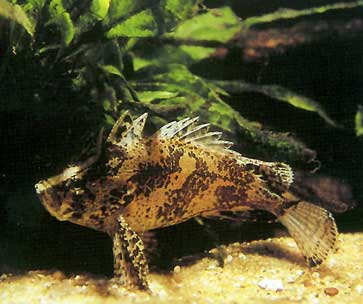
At my LFS they had a fish in the same tank as the green spotted puffer. if anyone can tell me anything about this fish please do because I couldn't find any decent information on it around the net because all species are HUGE gamefish. The one I saw in the store was gray and about 1 1/2 inches in length, but looks generally like all the pictures I looked at of other "larger" rockfish.

Rockfish?
Is this the fish you are talking about?
http://www.unizh.ch/~ehrengru/Scuba/rockfish.JPG
http://boydski.com/diving/photos/Fish/rockfisha.jpg
lesley
01-15-2003, 4:55 PM
Maybe some kind of sculpin? Most "rockfish" belong in the family Scorpaenidae if that helps...
cdawson
01-16-2003, 12:38 PM
The fish I saw LOOKS like a rockfish but it's only 1 1/2 inches long, they've been there for about 3 months. I don't think they're getting any bigger. If this helps, their movement is similiar to a goby, staying only at most 2 inches from the bottom. Generally though the pictures you sent match what I saw. I just would like to know whether it's a brackish fish or full marine. Most rockfish I'm aware are full marine as we've got plenty off the BC coast.
Javelin
01-16-2003, 1:24 PM
Sounds like a butterfly goby. I've got 3 of them. 1 1/2 inches is pretty much full size. They prefer live food, such as brine shrimp, but seem to be ok without it (I've never seen them go after flake food though). They have poisonous spines in their dorsal fin, so be careful when handling them. They seem to be pretty easy to take care of, and they're not agressive at all... Actually, they really like to try to hunt down ghost shrimp, but usually can't kill them.
Javelin
01-16-2003, 1:50 PM
Found a picture of one, 4th pic down:
www.atchison.com/CorysandBottomFish.htm
Notesthes-robusta, Bullrout
Vespicula depressifons, Leaf goblinfish/Freshwater Waspfish
cdawson
01-18-2003, 6:02 PM
that's it, a freshwater waspfish. Are they freshwater or brackish
Vespicula depressifrons
Leaf goblinfish
Vespicula depressifrons (Richardson, 1848)
Family: Tetrarogidae (Wasp fishes)
Order: Scorpaeniformes
Class: Actinopterygii (ray-finned fishes)
FishBase name: Leaf goblinfish
Max. size: 10.0 cm TL (male/unsexed; Ref. 7050)
Environment: demersal; freshwater; brackish; marine
Climate: tropical; 22 - 28°C
Importance: fisheries: of no interest
Distribution:
Gazetteer Indo-West Pacific: Indonesia, New Guinea, and the Philippines. Reports from Japan are erroneous.
Diagnosis: Dorsal spines (total): 13-14; Anal spines: 3-3. Body notably compressed. Orbit 9 - 10% SL. Dorsal soft rays 6.5-7.5; anal 4.5 (usually) to 5.5 (Ref. 39597).
Biology: Possesses venom glands at the base of some of the spines (Ref. 6192). Of no commercial interest but appear from time to time in the aquarium trade (Ref. 39597).
Red List Status: Not in IUCN Red List , (Ref. 36508)
Dangerous: venomous
cdawson
01-20-2003, 12:43 PM
what kind of venom are we talking here, I'd like to know the level of toxicity before I throw him into a tank =)
Bullrout & Freshwater waspfish venom I think are similar. (Not sure)
An investigation of the biological activity of bullrout (Notesthes robusta) venom.
Authors
Dr S. T. Hahn
Ms J. M. O'Connor
Journal
Toxicon 38 (2000) 79-89
Institute of origin
School of Natural and Complementary Medicine
Southern Cross University
Lismore NSW Australia
Running title
Investigation of bullrout venom activity
Address
Dr Scott Hahn
School of Natural and Complementary Medicine
Southern Cross University
PO Box 157
Lismore NSW 2480 Australia
Telephone: 02 6620 3948
Fax: 02 6620 3647
ABSTRACT
Bullrout envenomation is known to cause intense pain. Crude bullrout venom and venom fractions were assessed for protease, hyaluronidase, phospholipase and haemolytic activities, reactivity with stonefish antivenom, lethality to brine shrimp and ability to elicit pain in human subjects.
Compared with venom obtained from frozen specimens, live fish venom milking techniques rendered greater venom potency and improved storage characteristics. Although mild proteolytic and haemolytic activity was observed, crude venom demonstrated no hyaluronidase or phospholipase A2 activity, did not effect brine shrimp, or show antigenicity with stonefish antivenom. A single venom protein isolated from bullrout venom is attributed with causing pain in human subjects. The sensations elicited by this novel algesic protein are consistent with chemical stimulation of polymodal nociceptors.
http://www.scu.edu.au/schools/ncm/staff/scott/bullrout.html
http://www.scu.edu.au/schools/ncm/staff/scott/bullrout.pdf
History:
Pain
Immediately excruciating and incapacitating localized pain follows a sting from members of the Synanceia (stonefish) genus.
This pain may spread to involve the entire limb and regional lymph nodes, peaking at around 60-90 minutes and lasting up to 12 hours if untreated.
Mild subsequent pain may persist for days to weeks.
Less severe, although extremely painful, symptoms are seen following envenomation with members of the Scorpaena (scorpionfish) and Pterois (lionfish) genera.
Physical: The severity of envenomation depends upon multiple factors including the offending species, the number of stings, and the age and underlying health of the victim. Scorpaenidae stings are progressively more severe from Pterois (lionfish) to Scorpaena (scorpionfish) to Synanceia (stonefish).
Puncture wound
Classic envenomation reveals one or more puncture wounds, each discolored by a surrounding ring of bluish cyanotic tissue.
Subsequent edema, erythema, and warmth may involve the entire limb, although it rarely results in tissue necrosis in the absence of secondary infection (in marked contrast to stingray envenomation injuries).
Vesicle formation, particularly of the hands, may be followed by rapid tissue sloughing, cellulitis, and surrounding hypesthesia.
Systemic effects may be present (eg, nausea, muscle weakness, dyspnea, hypotension).