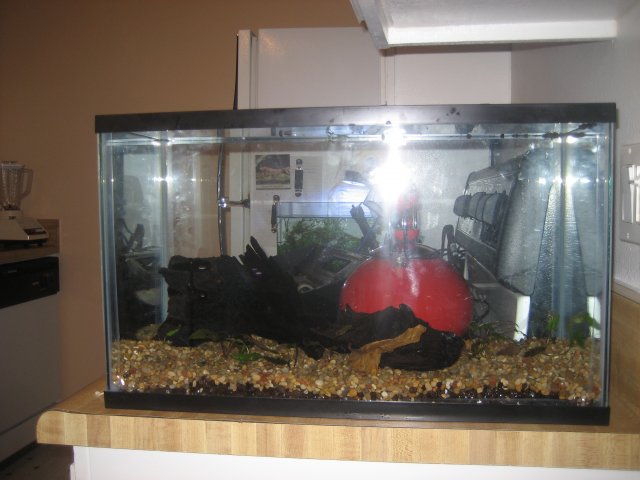
My Malaysian Peat Bog biotope tank thread. To some people this sort of tank is routine-to me it's not, and when I was searching around on the internet I could only find a couple of resources on how to set up the tank itself.
Parameters I am aiming for
PH: Below 5. But not too much below 5
KH:0
GH:0
Ammonia, nitrite: of course, 0
Nitrate: Below 10, preferably 5
Yesterday:
The tank, an $11.99 10 gallon from Petsmart. Also my dinner, my tea kettle, and my quarantine tank/plant nursery with new honey gourami .
.
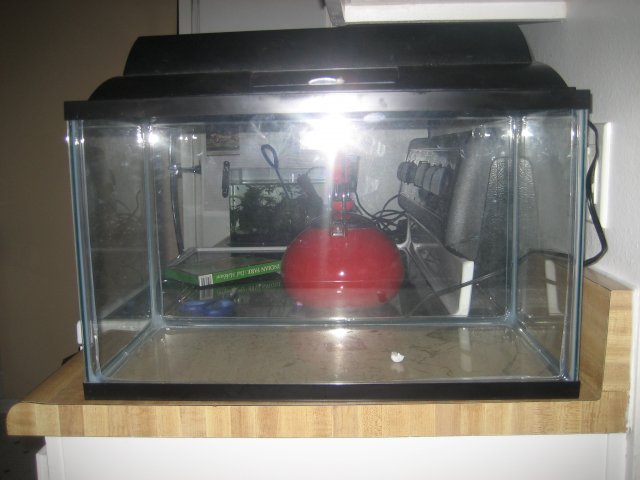
I had a free ten gallon I was going to use, but then discovered a crack in one of the sides. It was also encrusted in marine salts from its previous use and I was afraid of missing a spot while cleaning it and having this tank ruined. I decided to buy this tank after the 10 gallons came back up from $9.99 :headshake2:.
Granulized Peat, $9.99:
Finding the english on this box was challenging
I spread it in a thin layer along the bottom:
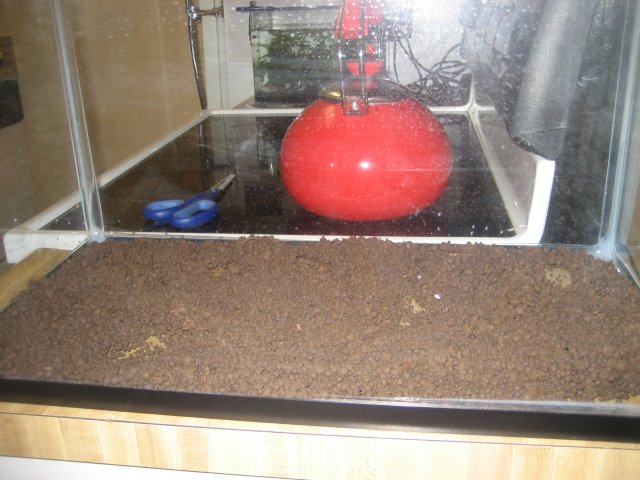
The substrate in Malaysian peat bogs(now, for the remainder of this thread, abbreviated as MPBs) is fine sand and high in organic material. I actually decided to go with gravel for this tank because I'm afraid of anearobic pockets building up as the peat decays. I've never heard of this happening, but I feel as if it's better to be safe than sorry. The other advantage to gravel is that the water was crystal clear when the tank was filled. I may switch out the substrate after time passes, though
After that, I started experimenting with the bogwood(Malaysian driftwood, laugh, four small pieces from Mgamer). It's hard to come up with a formation that looks natural, beautiful, and will provide five territories for licorice gouramis. I ended up with this:

The only plants aquatic plants that kept being mentioned when I was researching MPBs were Cryptocorynes sp. The tank was accordingly planted with baby Cryptocorynes wendtii from my other tanks, which, according to my knowledge, comes from all over asia.
I took out the bogwood(I wanted to see how the peat alone affected the PH, and the styrofoam needed to be scraped off) and filled 'er up with R/O "purified drinking water" from Ralphs. How long did that take? Too long, but not as long as it felt. I decided to pour it the way I did so that I wouldn't be impatient and accidentally drop three gallons of water on the floor.
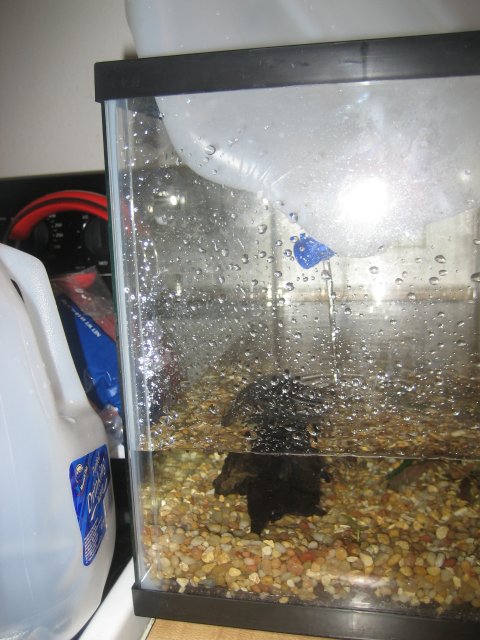
MBPs are nutrient deficent as they are isolated bodies of water without replenishment. This is why the PH and other things are so low. Things also happen to decay slower in this environment.
The honey gourami thought that all this was a great time to threaten his reflection.
I'm not sure why this is showing up at the bottom, but here is another shot of the peat.

Parameters I am aiming for
PH: Below 5. But not too much below 5
KH:0
GH:0
Ammonia, nitrite: of course, 0
Nitrate: Below 10, preferably 5
Yesterday:
The tank, an $11.99 10 gallon from Petsmart. Also my dinner, my tea kettle, and my quarantine tank/plant nursery with new honey gourami
. I had a free ten gallon I was going to use, but then discovered a crack in one of the sides. It was also encrusted in marine salts from its previous use and I was afraid of missing a spot while cleaning it and having this tank ruined. I decided to buy this tank after the 10 gallons came back up from $9.99 :headshake2:.
Granulized Peat, $9.99:
Finding the english on this box was challenging
I spread it in a thin layer along the bottom:
The substrate in Malaysian peat bogs(now, for the remainder of this thread, abbreviated as MPBs) is fine sand and high in organic material. I actually decided to go with gravel for this tank because I'm afraid of anearobic pockets building up as the peat decays. I've never heard of this happening, but I feel as if it's better to be safe than sorry. The other advantage to gravel is that the water was crystal clear when the tank was filled. I may switch out the substrate after time passes, though
After that, I started experimenting with the bogwood(Malaysian driftwood, laugh, four small pieces from Mgamer). It's hard to come up with a formation that looks natural, beautiful, and will provide five territories for licorice gouramis. I ended up with this:
The only plants aquatic plants that kept being mentioned when I was researching MPBs were Cryptocorynes sp. The tank was accordingly planted with baby Cryptocorynes wendtii from my other tanks, which, according to my knowledge, comes from all over asia.
I took out the bogwood(I wanted to see how the peat alone affected the PH, and the styrofoam needed to be scraped off) and filled 'er up with R/O "purified drinking water" from Ralphs. How long did that take? Too long, but not as long as it felt. I decided to pour it the way I did so that I wouldn't be impatient and accidentally drop three gallons of water on the floor.
MBPs are nutrient deficent as they are isolated bodies of water without replenishment. This is why the PH and other things are so low. Things also happen to decay slower in this environment.
The honey gourami thought that all this was a great time to threaten his reflection.
I'm not sure why this is showing up at the bottom, but here is another shot of the peat.
Last edited: