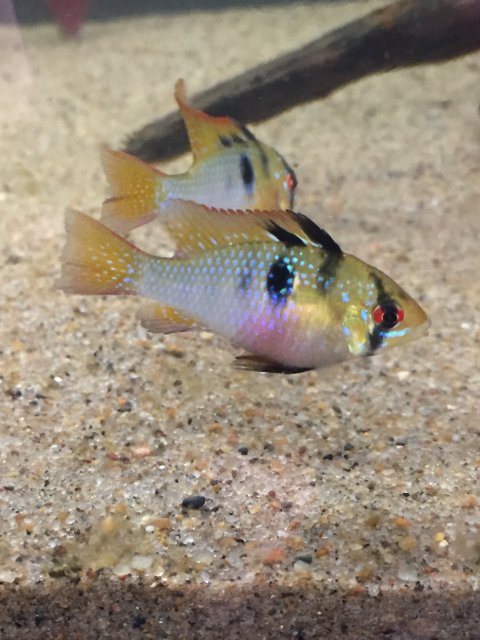
What is this?

In case you need measurement help & don't cook a lot, a TBSP = 3 teaspoons... & don't forget a bit of dechlorinator in your TX water, 2 drops of Prime/gal. Go slow but start. You can also mix up a heavy salt solution to add some tonight & more tomorrow. It really isn't an exact dosage, more ballpark-ish as is your tank's water volume, a 29g (or any tank) doesn't really hold that much. Say a 29g holds 25g, a 55g, 50 gallons, like that.

I hope I haven't confused the heck out of you! & if you do water changes w/vacuuming (you should!), you need some math to keep the dosage fairly constant. You don't want much of a roller coaster TDS effect, but you want effective dosing.

Oh, I see you posted while I was. That sounds like a safe & effective start...now do the math for tomorrow & beyond. Salt doesn't "go away" or break down, so it's a cumulative thing...minus water changes...yep, more math but not too difficult...You can do it!
 
Last edited:
Whoops! I misread! I will add 16 more tsp tonight. I did add some prime to the water I added. My tank is 75g. I need a refractometer. I have one at work but won’t be there until Monday. That way I would know what level I have my water at. I feel like a complete newbie. 10 years ago I was on here teaching everyone how to take care of their tanks. After all these years without tanks I’m crashing and burning. Thank you for helping me!
 
Oh, I was thinking you have a 29 or 55g, but still, you've gotten a safe start. You can add some a bit more if you stay up late enough tonight to observe. Go slow! (this is also how I acclimate new fish over hours or days).
 
  • Like
Reactions: DaisyTattoo
Here are two quotes from the below paper re salt treatment for ich. If you would like to read paper you can find it here http://dspace.stir.ac.uk/bitstream/...macho et al Parasitology Ich chemo review.pdf


REVIEW ARTICLE

An assessment of the use of drug and non-drug interventions in the treatment of Ichthyophthirius multifiliis Fouquet, 1876, a protozoan parasite of freshwater fish

S . M . P I C Ó N - CA M AC H O1 * , M . M A R CO S - LO PE Z 2 , J . E . B RO N 1 and A . P. S H I N N 1
1 Institute of Aquaculture, University of Stirling, FK9 4LA Stirling, UK
2 Marine Laboratory, 375 Victoria Rd, AB11 9DB Aberdeen, UK

(Received 17 June 2011; revised 12 September 2011; accepted 16 September 2011; first published online 14 November 2011)

A S S E S S M E N T O F C U R R E N T L Y A P P L I E D C H E M O T H E R A P I E S

A large number of compounds have been tested for efficacy against I. multifiliis although relatively few of them have been widely deployed to provide effective control under field conditions. Table 1 provides a detailed list of 116 compounds used to control I. multifiliis under laboratory or field conditions from 1980 onwards. Of the compounds that are
listed, all except quinine and some malachite green based formulations have been tested against food fish species. These latter treatments, however, that have been evaluated for the ornamental trade, are included to provide a comprehensive overview of all compounds tested for the treatment of I. multifiliis.......

Sodium chloride

Sodium chloride (salt) is the second most commonly used product for the treatment of I. multifiliis infections. The application of a minimum of 2·5 g l− 1 has been proven to reduce protomont and theront survival (Aihua and Buchmann, 2001; Shinn et al. 2005; Lahnsteiner and Weismann, 2007). A treatment regime of 1–5 g l− 1 salt applied continuously for a minimum period of 7 to 32 days, for example, was able to reduce the number of trophonts establishing on fish (Selosse and Rowland, 1990; Miron et al. 2003; Lahnsteiner and Weismann, 2007; Balta et al. 2008; Mifsud and Rowland, 2008). The use of higher concentrations of salt (e.g. 15–20 g l− 1) over short periods of exposure (e.g. 20–60 min), however, was not able to reduce the level of infection (Lahnsteiner and Weismann, 2007; Balta et al. 2008). Additionally, the bath application of salt may be beneficial, in helping the host recover the osmotic imbalance and loss of salts created by exiting trophonts. The incorporation of salt in fish feed has also been explored with contradictory results. Rahkonen and Koski (2002) reported a reduction in infection levels in medicated fish when salt was incorporated at a level of 0·3–1·0% and fed for 3 to 11 days. Garcia et al. (2007), however, did not observe any significant reduction in parasite burdens when fish were fed a diet containing 1·2–6·0% salt for a period of 30 days. While the use of salt appears to represent an economically viable and safe treatment option for many farm and ornamental fish species, it should be used with caution in certain infected stenohaline freshwater fish species such as channel catfish (Noga, 2010).

I have only battled ich three time in 19 years. I did not have good luck with salt and raised temps when it was used with plecos or tetras. I used this product with success and it is what I keep in my med kit JIK I see ich again. Mardel Quick Cure whic is Formalin and Malachite Green

Heat does not kill ich what it does is accellerate their life cycle. From the above study
The life cycle involves 4 different stages: (1) the trophont, which resides within the surface epithelium of gills, fins and other body surfaces; (2) the protomont, a free-swimming stage that exits the fish and settles on the substrate to become the encysted tomocyst stage (3) which in turn repeatedly divides by binary fission to produce tomites which are released to the water column. Tomites differentiate into the infective stage (4) the theront, which needs to find a host within a short window to successfully complete the life cycle by penetrating the epidermis and developing into the trophont stage before it dies (Lom and Dyková, 1992; Matthews, 2005).

Different ich treatment may kill ich in different stages. Some treament will work in multiple stages. Table 1 in the study reports on salt treatments administered in various ways, doses and durations and how much of the ich was killed in which life cycle stage.
 
  • Like
Reactions: DaisyTattoo
Keep in mind the different ich stages & keep up the treatment for at least a week after all signs are gone. You don't want to have to do this all over again by being too optimistic too soon.

What salt dosage are you planning to use? I admit I have trouble with grams/liter, lol.

Interesting study TTA. I know I have used both malachite green & methylene blue at different times in the past. but I see malachite is much more effective. I, like you, have a fish "drug stash" on hand but I haven't had ich in many years (fingers crossed).
 
Thank you for the article TTA. I will check it out. I’ve only had ich one other time, over a decade ago. I did use salt and heat but honestly don’t remember if the affected fish survived treatment. I do remember thinking it worked so it must have went ok. Although I was much younger and inexperienced then.

Fishorama, I think I am going to aim for 2 tsp per gallon. From the articles I’ve come across thus far that seems to be the sweet spot. Adding very slowly of course. I’m hoping I don’t kill my cories or Plecos, but I’d rather my angels and rams survive. If I see anyone struggling too much I will lower the concentration. Tank is steady at 88* right now. It’s very lightly stocked(5 small/Med angels, 2 rams, 3 Cory cats, and 3 super small Plecos) and I have the waterline lowered so HOB filter is creating plenty of oxygen. The spots on the rams are almost gone today. Hoping more don’t reappear.
 
The ich did not survive long at 88 degrees, but the Cories may not either. That's scary warm for them.
I'd lower the temp back to 86 degrees next morning at earliest.
If there are no signs of new ich in the morning I'd say you are good to go. Just lower temp gradually and the salt will resolve over a few water changes.
 
  • Like
Reactions: DaisyTattoo
Well, that's the first stage, or almost. I think you made a good choice on the salt dosage...& to go slowly.

No slacking on water changes with vacuuming, the more you can do, the better off your fish will be!! Just try to estimate the amount of water you remove, say 5-10 gallons or more each time. Once you get to full salt dosing it's easier figure out.

Good luck!!
 
  • Like
Reactions: DaisyTattoo
AquariaCentral.com