deformed guppy/endler hybrids

i haven't seen a study on it , only for cold water species like salmon/trout, doesn't mean there hasn't been, but to get nitrates that low is extremely hard... for me anyways , i have them at 30 ppm right now and all my fish even very sensitive rainbows seem to be absolutely healthy and my rainbows have been in the tank for 2 years with way higher nitrates than 30, they were once at 80-100 , i am still new to this but every single fish keeper i know IRL , as well as my lfs said not to "fret" over nitrates just do my best to keep them on the lower side, i am getting different gravel soon so it should help as right now food, debris you name it gets trapped in the substrate.

so how do you get them to 0 im assuming lots of plants, regular 50 % water changes a week
and if at 0 wont your tank recycle? (like i said i am still learning slowly but surely)

as far as plants go im totally lost on that , i dose what i was recommended which is flourish excel, flourish comprehensive and root tabs.
 
Because study species are often kept in setups similar to those that we have at home, there were studies on the effects of waste on their growth and development to ensure that researchers were not adding any confounding factors to experiments. While you may not be seeing any differences in your fish, there very well still might be. A lot of these things are internal, organ and tissue development, hormonal levels etc and also include changes in growth rate and reproductive output as well as behavioural variation. There's a lot going on inside that I think many people don't often think about.

I wouldn't say to constantly worry about nitrates, but they should be a presence in the back of your mind that you are always thinking about.

Nitrates can be kept low by having plants, keeping stocking minimal and not overfeeding as well as sticking to a water change schedule.

I'll give you an example of my low nitrate tank. My last tank before my move to Scotland where I haven't been able to secure a flat for long enough that I feel comfortable setting one up, was a 35 gallon almost squarish tank low tank (it was like 4 ten gallons made into a cube = lots of surface area for gas exchange). In it was about 3 large anubias nana (20+ leaves on each), a handful of cryptocoryne wendti and undulata, 2 medium size java ferns and a handful of java moss. So, not densely planted, but not sparse either. I had a school of 10 albino neon tetras, 6 raspora hets, 6 mountain minnows, 2 L10 lizard cats, a male betta, a rubber lip pleco, and a handful of nerite snails. I planned to add a school of pygmy cories, but my move came sooner than I thought. I had a fast day in my feeding and that was water change day, fish digest better when not stressed. The snails and the cats ate repashy or homemade food (messy) and the fish got a variety of micropellets and frozen foods, so it was messy food even though it was fed lightly. However, because of the stock level and the plants, I changed about 20% of the water once a week and my nitrates rarely ever registered as 5 ppm. Its doable with small fish much easier, but it is doable and fairly simple. I rarely dosed anything for my plants except some liquid ferts once a month and excel when I remembered, but my plants were very low maintenance on purpose.

What we register with kits as zero isn't always zero as our kits are not that sensitive. Nitrates at zero won't cause a tank to recycle, because the fish are still putting in waste, its just getting used up and taken out a such a rate its not registering on the kit.
 
Because study species are often kept in setups similar to those that we have at home, there were studies on the effects of waste on their growth and development to ensure that researchers were not adding any confounding factors to experiments. While you may not be seeing any differences in your fish, there very well still might be. A lot of these things are internal, organ and tissue development, hormonal levels etc and also include changes in growth rate and reproductive output as well as behavioural variation. There's a lot going on inside that I think many people don't often think about.

I wouldn't say to constantly worry about nitrates, but they should be a presence in the back of your mind that you are always thinking about.

Nitrates can be kept low by having plants, keeping stocking minimal and not overfeeding as well as sticking to a water change schedule.

I'll give you an example of my low nitrate tank. My last tank before my move to Scotland where I haven't been able to secure a flat for long enough that I feel comfortable setting one up, was a 35 gallon almost squarish tank low tank (it was like 4 ten gallons made into a cube = lots of surface area for gas exchange). In it was about 3 large anubias nana (20+ leaves on each), a handful of cryptocoryne wendti and undulata, 2 medium size java ferns and a handful of java moss. So, not densely planted, but not sparse either. I had a school of 10 albino neon tetras, 6 raspora hets, 6 mountain minnows, 2 L10 lizard cats, a male betta, a rubber lip pleco, and a handful of nerite snails. I planned to add a school of pygmy cories, but my move came sooner than I thought. I had a fast day in my feeding and that was water change day, fish digest better when not stressed. The snails and the cats ate repashy or homemade food (messy) and the fish got a variety of micropellets and frozen foods, so it was messy food even though it was fed lightly. However, because of the stock level and the plants, I changed about 20% of the water once a week and my nitrates rarely ever registered as 5 ppm. Its doable with small fish much easier, but it is doable and fairly simple. I rarely dosed anything for my plants except some liquid ferts once a month and excel when I remembered, but my plants were very low maintenance on purpose.

What we register with kits as zero isn't always zero as our kits are not that sensitive. Nitrates at zero won't cause a tank to recycle, because the fish are still putting in waste, its just getting used up and taken out a such a rate its not registering on the kit.

sounds good... but with my tank setup theres absolutely no way to get them below i would say 30 i have very very thick gravel that debris gets trapped in easily so i have to vac once a week and do 50% water changes to even get it to 30 even with very strong filtration (14.5 turnover rate) it was 60-80 last month because i was over feeding.

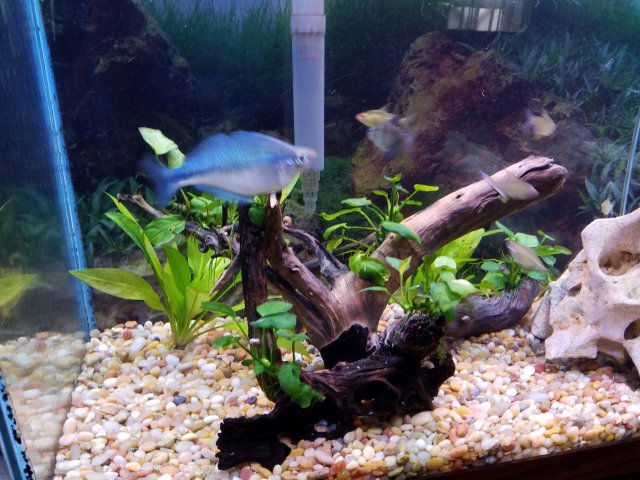
i only have a few anubias (small splits i got off a bigger one that are starting to grow back that are attached to drift wood) and 2 swords, i havent had the money to go get more drift wood to do the other side of the tank where it will be ferns, anubias, vals, moss and maybe a crypt, but i dont know if i have the lighting to do that... my plants are not deep green they are like a neon green not dark like they should be, it is a 48" elive led fixture packed full of pods.

i have to get different substrate but i am petrified i will cycle the tank even though i know how to do it with my tank being absolutely perfect from what i observe if i crashed the tank i would be devistated.

This is a horrible pic lol but as you can see the plants are not deep green

20161129_082823.jpg
 
Last edited:
That's a very lightly planted tank, and anubias are incredibly slow growing. If you used a faster growth plant--most stem plants, for example, they would consume the wastes much faster. Keep in mind that in a heavily planted tank, fertilizing for macro and micro nutrients is pretty much required---and that includes carbon, usually via injected CO2. That's not required for a healthy moderately planted tank, but slow plant growth won't get nitrates to 0.
 
If they've dropped that much you're on the right track! It sounds like you're doing what you need to in order to continue them dropping. I wouldn't worry about ending up with a cycle when you're changing gravel. Having two HOB filters should give you enough bacteria to prevent that. Just don't clean the filters the same week as you change the gravel and you should be dandy.
 
That's a very lightly planted tank, and anubias are incredibly slow growing. If you used a faster growth plant--most stem plants, for example, they would consume the wastes much faster. Keep in mind that in a heavily planted tank, fertilizing for macro and micro nutrients is pretty much required---and that includes carbon, usually via injected CO2. That's not required for a healthy moderately planted tank, but slow plant growth won't get nitrates to 0.
i would need injected co2 if i just stayed with say anubias ,swords,ferns, vals and moss? well there goes that idea cause i cannot afford the system to do it , i know theres dyi co2 but im not trying to get that deep into it even though i love a planted tank, maybe if myy anxiety wasnt so high i could do it but as of right now i wouldnt be able to.
 
If they've dropped that much you're on the right track! It sounds like you're doing what you need to in order to continue them dropping. I wouldn't worry about ending up with a cycle when you're changing gravel. Having two HOB filters should give you enough bacteria to prevent that. Just don't clean the filters the same week as you change the gravel and you should be dandy.

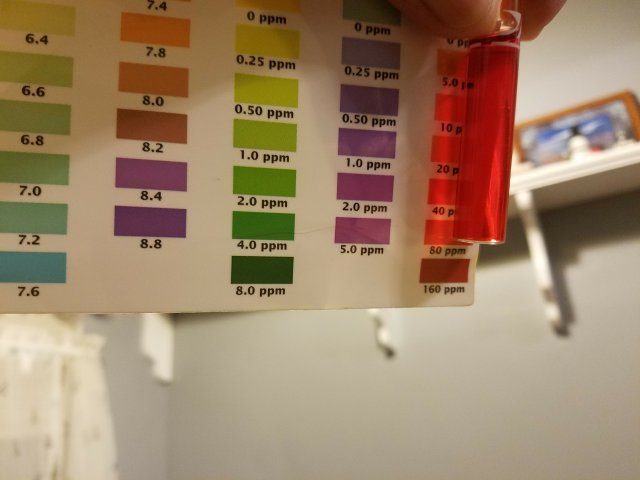
they were high before i got the swords they might still be higher than what i said as i have a very hard time reading the different shades of orange , i dont want to go to dirt or sand, what substrate would you all recommend to use if i only did a few root feeders, swords,vals to as fern moss and anubias are water column and should be attached to decor, driftwood, rock etc etc.?

20161127_040735_001 (1).jpg
 
If you don't want to go sand, just go with the finest gravel you can find. I always liked eco-complete because it is a sand gravel mix. Your swords will really prefer a finer substrate. You might think of adding something that grows faster, like a stem plant or a cryptocoryne as the nitrates do look like they are hovering around 80 or a little higher (but its hard to tell from pics tbh).
If you're having that much trouble with nitrates you might think about doing two water changes a week instead of just one and see if that helps at all.
 
If you don't want to go sand, just go with the finest gravel you can find. I always liked eco-complete because it is a sand gravel mix. Your swords will really prefer a finer substrate. You might think of adding something that grows faster, like a stem plant or a cryptocoryne as the nitrates do look like they are hovering around 80 or a little higher (but its hard to tell from pics tbh).
If you're having that much trouble with nitrates you might think about doing two water changes a week instead of just one and see if that helps at all.
its not 80 i dont think, 20 doesnt show through the test tube 40 shows through... lol its the only way i can actually try to tell the difference , i hold the tube up in front of the oranges and whichever one doesnt show through the tube i go with lol probably the wrong way to determine the ppm and yes my cam on my phone makes things look darker i know it should be like orange/ darker yellow, wish they had a different nitrate test kit with different colors like 20 is orange 40 is green 80 is purple lol, i was told doing 1 bigger water change will reduce the nitrates more than 2 smaller ones cause i was doing 2 30% weekly not i am doing 1 50%, i also read that you should never have to take out more than 30%.if your tank iss properly balanced.

but i think if i get finer gravel it will help with the nitrates cause the food / waste wont be able to bury itself in the substrate.
 
No, C02 isn't needed for the slow growth plants you have. I was just saying that the fast levels of growth needed to have plants really reduce nitogren compounds required C02.

Have you verified that your source water isn't introducing nitrates?.
 
AquariaCentral.com